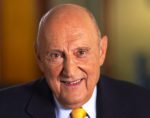
Burt Malkiel

John Rothmann – I’m John Rothmann, and as we’ve promised we have a very special guest joining us.  Mitch, tell us about this remarkable individual.

Mitch Tuchman – We’re so excited, we have Professor Burt Malkiel on with us, and Burt is a member of our Investment Committee at Rebalance. Burt wrote a book that I read when I was in college in the 70s, and I think millions of others have read the same book. It’s called A Random Walk Down Wall Street and it was published 40 years ago and it’s now in its eleventh edition. It is not 50 Shades of Grey, but it has sold 1.5 million copies and for finance that’s getting up there.

John Rothmann – Before we get going, Burt I have to ask you a question right out of the box – the most famous quote – a blindfolded chimpanzee can throw darts and do better than the pros. How in the world did you come up with that?

Professor Burton Malkiel – The fact is that what I have done from the very first edition of the book is to recommend so called “index funds”. Now an index fund is simply a fund that buys and holds all the stocks in the market, and the reason that that does so well is that there are a lot of smart people around who hear some information and that are buying and selling to make sure that any information that arises about a stock or the whole market gets reflected in its price.  Now that doesn’t mean the price is always right, in fact I like to say the price is always wrong, but the point is millions of Americans including very highly paid professionals are buying and selling and if they think the price is wrong they’re going to make transactions to change that price.  So the price really reflects everything that’s known about a stock. Therefore, if you just take the prices that are there and buy and hold, you’re going to do at least as well, if not better than all of the other people. In the other words, if the prices reflect the information a blindfolded monkey throwing darts can select a portfolio as well as the experts.

John Rothmann – But Burt I got a tip, I want you to know that, and you’re the first one to hear this – a company called Enron if I put all my money there I’m going to be able to retire with more than I could ever imagine. Not a good idea right?

Professor Burton Malkiel – No, not a great idea.  You happened to take a company that used to be a very admired company, but that was basically a fraud that was built on a number of lies and the price was actually wrong.  It does not mean that there aren’t some fraudulent people around or that there aren’t some Bernie Madoff’s around. You could do a lot worse than the blindfolded chimpanzee by simply following “tips”

Mitch Tuchman – So you have now published eleven editions of A Random Walk Down Wall Street and the original message was indexing, but there were other messages. Talk about some of the basic tenants that you put forth forty years ago and whether or not you still believe in them all still or if you have had any doubts about some of them.

Professor Burton Malkiel – I believe in indexing, the main tenant, even stronger than I did when I first wrote the book.  When I first wrote the book, index funds didn’t exist.  Three years later, Jack Bogle at Vanguard Group started the first index funds and index funds have proliferated.  There has been a lot of competition.  Their prices have been driven down so that you can then buy index funds close to zero cost.  More recently there are so called Exchange Traded Funds (ETFs), and these are index funds that trade very much like stocks, and again can be bought at expense ratios that are very close to zero.  So the fact is that from the first thought of doing this forty years ago to when they didn’t even exist, they now exist and they are almost costless and the data from the period from which you‘ve had index funds, the data is overwhelming that each year the index funds does better than 2/3 of so called “active” managers who try to pick the great stocks and the 1/3 that seem to win in any one year are not the same who do better in the next year. When you look over 20-30 years, its just overwhelming that 90-95% of active managers are beaten by the index.  What I like to say about markets is we all need to be cautious and modest about what we know and what we don’t know, but the one thing that I’m absolute sure about is that the lower the expense that I pay to the purveyor of the investment service, the better that I’m going to be and the more money there’s going to be for me.  So indexing remains one of the biggest lessons, but as you said Mitch, there are others and one of them, one of the great lessons, is the name of your company Rebalance.  I believe and have believed for years, and have the data to show that it works, the simple idea of rebalancing works wonders for a portfolio in that in that it always reduces the risk of the portfolio and in very volatile markets it will tend to increase your portfolio’s return

Mitch Tuchman – Rebalancing is a great concept that I learned early on from the book.  It’s a very hard to grasp concept to grasp sometimes because the financial world continues to tell the people that they are predicting this or predicting that and that forms the basis of making a change in the portfolio and what you recommended forty years ago and what we do is very different, isn’t it?

Professor Burton Malkiel – Look, nobody, and I mean nobody, can predict what the market is going to do, next week, next month, next year.  I started my career on Wall Street.  I have been in this business for more than forty years. I have never known anyone to be able to successfully predict the market over time.  You can get it right once in a while, but to do it consistently over time, I’ve never known anyone who could do it, and in fact I’ve never known anyone who knows anyone who could consistently predict the market.  What rebalancing tells you to do is this – if you’ve got a portfolio, which lets say, has some equities or some common stocks, and has some safe securities such as bonds and you want to have a balanced portfolio that’s let’s say 60% stocks, and 40% more fixed income, bonds, preferred stocks etc., that what you do is, you look at your portfolio periodically and you ask what’s happened?

Have you gone through a period such as the period during the internet bubble at the beginning of the 2000s where the stocks just went crazy up and the bonds were going down so instead of a 60:40 portfolio, you’re stocks were at 75% and your fixed income was 25%. What rebalancing tells you to do is take a little money off of the table, take the proportions down to that 60:40 that you’re comfortable with. You know it’s almost as if we’d all like a genie to tell us when the markets too high, when we should get out and nearest thing to it, is rebalancing.  Basically what this does is remove some of the risks of a portfolio, particularly when one asset class gets too popular and it will in volatile markets tend to increase your returns.

John Rothmann – Burt that’s my question for you, lets go back to 2008 when everything seemed to fall apart, if I had been involved in a rebalance would it have made a difference for me in terms of my investments?

Professor Burton Malkiel – Absolutely.  One of the mistakes that people made in 2008, and this is one of the other things that I pay a lot attention to particularly in more recent editions of the book, is so called “behavioral finance.” Sometimes in investing we are our own worst enemies and what we know that we do as individuals is we buy when everybody is optimistic, as people were in the beginning of 2000 and during a period like 2008 when the world seemed to be falling apart that’s when we tend to sell.  What rebalancing forces you to do, is to do just the opposite of what your instincts tell you because your instincts are always going to be wrong.  What rebalancing told you in 2008 was the stock market was low – instead of 60% in stocks, you may be only had 33-40% in stocks. Since the bond market was way up because the monetary authorities were reducing interest rates down to zero, bonds were way up. Instead, sell your bonds and buy more stocks so rebalancing protects you from these behavioral problems that you have, buying when you’re optimistic, selling when you’re pessimistic, and what it would have done in 2008 is got you more into the market at just the right time.

John Rothmann Burt, I want to point out that you do serve on the Rebalance Investment Committee with Mitch and his partner Scott. We are going to take that break and when we come back, we are going to have a series of more questions for you. We will be right back, with the man who impresses me amazingly.

Forget about the upheaval in the Middle East. Don’t dwell on Russia’s war with Ukraine, U.S. tariffs and the budget deficit — or just about anything else that has been dominating news coverage and threatening to undermine the markets.

These issues are critical right now, undeniably. But history suggests that they will be irrelevant in your investing life, if your horizon is long enough.

Instead, focus on just one thing: the remarkable record of compounded, reinvested stock returns over many decades. That’s the message of Charles D. Ellis, a pioneer of diversified index fund investing, who has distilled decades of experience and study into a deliberately simple new book, published in February by Wiley: “Rethinking Investing: A Very Short Guide to Very Long-Term Investing.”

“The secret to investing, in my view, is time,” Mr. Ellis, 87, told me in a telephone conversation. “How much time is there between now, when you invest the money, and when you’re going to spend the money. By ‘long term,’ most people think six months, maybe a year, maybe even a few years.”

I’ve said in many columns that, based on history, a long-term investor needed to stay in the stock market for at least a decade, and preferably longer, to have a high probability of an excellent return. Mr. Ellis said that’s still too short to enjoy all the benefits of long-term investing. Instead, Mr. Ellis advised, think 60 years — or longer.

Really, I asked? Who has that kind of investing horizon?

“Actually, many of us have,” he said. “Say you start in your mid-20s and you continue through your mid-80s. And then, if you’re lucky, you can go longer than that.”

He acknowledged that he has been lucky — well-educated, healthy, still working and with enough ready money to pay the bills throughout his life, allowing him to sock away investments in the stock market, despite its ups and downs.

But at his age, I said, surely, his investing horizon has become much shorter than 60 years.

“Not really,” he said. Obviously, now that he is in his late 80s, his life expectancy isn’t what it once was. “But if you ask me, who am I investing for today, it’s for my grandsons and granddaughters,” he said. “They’ve got a long time ahead of them.”


Read the rest of the article on The New York Times website.

WASHINGTON, D.C., Jan. 31, 2022 — The National Geographic Society today named Kristi Craig as Chief Investment Officer and Tony Luckett as Vice President of Business Development. Both newly created roles speak to the National Geographic Society’s goal of creating a more robust and innovative business model as outlined in its NG Next strategic plan.

Craig currently serves as the Director of Private Investments at Georgetown University and will begin her role with the National Geographic Society on February 15. Luckett most recently led several strategic partnerships for Meta (formerly known as Facebook) and begins his new role with the Society today.

“As the global economic landscape evolves, the Society must grow and adapt with it,” said National Geographic Society President and Chief Operating Officer Michael L. Ulica. “To ensure we have the strongest possible financial future and to deliver on our NG Next strategic plan, we need to be innovative in our investments and partnerships. We’re thrilled that Kristi and Tony — both forward-thinking, exemplary leaders who embrace the Society’s vision — are joining to further our mission.”

As the Society’s first-ever chief investment officer, Craig will oversee a $1.4 billion endowment, working closely with the Society’s Investment Committee of the Board of Trustees. She will lead and continue to build a differentiated and successful investment portfolio while contributing to the Society’s growth and mission.

“I’ve long been passionate about creating and pursuing investment opportunities that help better our communities,” said Craig. “I’m excited to guide the Society’s investment decisions in a thoughtful and strategic manner that lives up to the organization’s mission to illuminate and protect the wonder of the world.”

In his role as the vice president of business development, Luckett will be responsible for leading a team to expand the reach and mission of the Society through new products and services. In collaboration with the senior leadership team, Luckett will look for creative and strategic ways to elevate the Society through its partnership with The Walt Disney Company.

“National Geographic has inspired me as both a former educator and a passionate storyteller,” said Luckett. “I couldn’t be happier to join this organization as it looks to expand on its impact around the world at such a pivotal time. I’m especially excited at the opportunity to explore new partnerships and opportunities for a brand that I’ve always admired.”

John Rothmann – I’m John Rothmann…

Mitch Tuchman – And I’m Mitch Tuchman.

John Rothmann – …and our guest on the Retire With More Program is Jay Vivian. He is the man who oversaw the retirement funds — $135 billion in retirement funds for IBM — and when we left off, Mitch, I was on the edge of my chair because he had two conflicting views and, gosh, I’m so indecisive, how do you decide, Mitch?

Mitch Tuchman – Well, let’s set this up a little bit. So, when you’re Jay Vivian and you’re running this kind of money, every smart money manager in the world comes in to see you.

Jay Vivian – Oh, the dumb ones do, too, Mitch.

Mitch Tuchman – And the dumb ones do, the smart ones and the dumb ones! But when they get to see you, you do have access, and so you were telling a great story about how one guy comes in in the morning and says our fund’s going to go long Japan. We see an amazing opportunity. And then that afternoon another guy came in and he says we’re going to sell Japan short, and what did you guys do? I mean two smart guys, conflicting views, great performance…

Jay Vivian – Essentially, we learned that having a really smart guy doesn’t really help you that much, and it’s really hard to make a decision like that, and it comes down to the fact that I ended up, certainly, believing that indexing was the way to go in a lot of areas. Certainly in an area like large-cap stocks. Certainly in trying to time markets and trying to time interest rates, because there’s a ton of smart people out there and they disagree even with each other. So, if they can’t figure it out, how the heck can I figure it out in an ivory tower, like an academic, or in a corporate plan? It’s just really hard to do that. So what you do is you say you know, unless I’m really convinced that I’m smarter than all those guys and gals down on Wall Street, I really shouldn’t try to play in that space.

Mitch Tuchman – And therefore, if I’m not going to play in that space, my default, the other choice is simply to ride the markets and capture those returns, right? And that’s what you decided to do with billions and billions of dollars for IBM employees.

John Rothmann – And Jay, what you’re logically saying, then, is that the safer way to go, but not only safer way to go, the smarter way to go, is what you and Mitch are recommending in Rebalance, and that is to go with an index fund. And just so everyone is clear, can you just quickly define for us, very simply, what exactly is an index fund?

Jay Vivian – You bet. It’s called an index fund because it’s managed against an index and an index is something like the S&P 500 Index, which is the 500 large industrials, and an index fund is a fund which instead of trying to figure out which of those stocks is going to do better and which is going to worse, just says you know, I’m not sure I’m smart enough to do out, let’s just buy the 500 stocks in the S&P 500 and ride them.

The reaction that most people have to that idea of just buying the index or buying an index fund, which replicates the index, the negative reaction is well, you can’t be the index then, so you’re always going to underperform. Well, the answer is you’re not always going to underperform. If it’s a well-managed index fund you’re going to earn the index. And yeah, you’re not going to outperform, but guess what? You’re also not going to underperform. And it turns out that that’s where the real the problem is. It’s like a lot of games that you play, you don’t always win the game by beating the other team at what they’re doing. What you do is end up losing the game by losing.

Look at a game like hockey. How do you win the game? Yeah, you win the game by scoring goals, but you lose the game by letting the other team score goals against you. Same thing with indexing. If you don’t lose, if you can avoid those darn losses, you can on average do better than many of the other participants. This has been particularly true in the last five years, where active managers have underperformed index funds in large numbers, 60%, 70%, by some measures 80% of active managers have unperformed in the last couple years.

Mitch Tuchman – So let’s get back to these target-date funds. We were talking about a target-date fund, has a date on it. That is the date you retire. I think to the average investor who is getting into his 401(k), they think, well, I’m 50 years old, it’s 2015. I’ll probably retire at 65. That’s 2030. I pick the target date 2030 and that’s the end of it. I would say that’s probably a very shortsighted thing to do. Can you help somebody understand what else they should be doing besides just picking a random date on a target-date fund?

Jay Vivian – Well, one thing is, is that going to be enough? One of the worst decisions that people make is how much to defer, how much to save. That’s something that’s a hard judgment to say because you don’t know how long you’re going to live. So 2030, that may well be when you’re going to retire, if you’re going to retire 15 years from now. The bigger question is, how long are you going to live?

Mitch Tuchman – I wish I knew!

Jay Vivian – If you knew that you were going to die in 2030, sad story that you’re only going to live 15 years, but you might not need to save as much. If you knew you were going to live to be 99 like my grandfather did, you’ve got a bigger problem. You’ve got to save a heck of a lot more money and you’ve got to be a lot more careful how much you spend in fees. You’ve got to be a lot more careful that your portfolio is well-diversified. You’ve got to be a lot more careful that you’re protected against other things that might happen between now and then, like healthcare and kids that need help and whatever other expenses you have. So, picking 2030, yeah, that’s a good choice if you’re 50 and you’re going to retire in 15 years, but you’ve got a bunch of other things that you’ve got to think about, too.

Mitch Tuchman – Well, you know, Jay at Rebalance when we’re talking to clients who have these target-date funds in their 401(k) — and we do advise people on money we don’t manage as well as the IRAs that we do, because we like everything to be holistic with our clients — but when we’re looking at these target-date funds, I’m always amazed at how “off” they are. So, guy says to me I’m 50 and I’m going to retire at 65. I look at his target-date fund and there’s just not enough equities in this target-date fund, or when you kind of look at things, he probably ought to be at a much further out target-date fund. And I think that we’re always talking at these glide paths and they’re deceptively easy-looking but they’re really not easy at all.

Jay Vivian – That’s right. I mean, a 2030 fund, for example, that sounds pretty far away, but somebody who’s 50 years old might say, you know, I ought to be taking the risk down, but a 2030 fund really ought to have 70%, maybe 80% equities in it because not only does that fund have to survive the 15 years from now — again we’re talking about a 50-year-old hypothetical investor — until 65, but the average 50-year-old today probably has between 35 and 40 years of life left…35 and 40 years, that’s a long time! So that’s why that investor, even though they may not feel comfortable holding 60%, 70%, 80% in stocks, if they’re going to be living 30, 40, maybe even 50 years, like my grandfather, from age 50, you’ve got some serious thinking to do.

Mitch Tuchman – And Jay, in the industry, these glide paths, and maybe you can explain what a glide path is after I finish my question, but these glide paths, they’re different from purveyor to purveyor to purveyor and, to me, these glide paths were also devised when you could make money on bonds. Now we’ve got depressed bond prices. So, how do you think about glide paths and what should a regular, everyday investor do about that?

Jay Vivian – Well, I like the idea of glide paths for two reasons. One, these funds all automatically rebalance…

John Rothmann – Explain what a glide path is, though.

Jay Vivian – Within a given family of target-date funds there is a typical glide path, and the glide path, what it does is, over time, it gradually takes your risk down. So, for example, the 2030 fund, let’s just say, hypothetically, that the target-date fund at one of these fund families we were talking about a little while ago is 75% in stocks. That number might actually stay at 75% for the next 10 years. So our 50-year-old, when he turns 60 in 2025, it might still have 75% in it. But then it will slowly decrease. So the same fund, the same fund at Vanguard we used as an example before, the 2030 fund, this fund will be around for 50 or 75 years, but that fund’s target equity weight will slowly come down over time as its investors slowly age — or people at least that say they want to invest with the risk associated with retiring in 2030 — that will slowly come down.

Now the 2025 fund is for people who retire a little early. That equity weight will start to come down sooner. The 2050 fund might have, I don’t know, 85% in it now, we could look it up online in a second, and that’s going to come down later. So, if you think about it, and this is hard to do on the radio, but there’s actually a chart that each of these providers has that shows the equity weight at different numbers of years from now.

Mitch Tuchman – It just looks kind of like a plane kind of coming down for a landing.

John Rothmann – Gliding. Gliding to a landing. But I have to ask you a question: So, if I’m 50 years old and I’m planning my retirement, how do I know, what are the benchmarks that I should look for in terms of what I’m going to need to retire? I’ve got to pay my mortgage, my life insurance, property taxes, all these things. How do I figure it out?

Jay Vivian – That’s a very, very hard question, John. The most important one is one we talked about a minute ago, how long you’re going to live? So tell me that.

John Rothmann – If I knew the answer to that, boy, would I have a life insurance policy for you!

Jay Vivian – So, it’s a very hard thing to do, John. What you have to do is you have to try to reduce the risk. The biggest risk, strangely, is that you live a long time because if you live a long time, that means you’ve got to have more money. So you’re right, you’ve got to think about your mortgage. You’ve got to think about your retirement. You’ve got to think about the things you might want to do in retirement. You know, you want to buy that vacation home on the coast? Maybe. Do you want to leave money for your kids? Maybe. Do you want to take that vacation to Outer Mongolia that you always wanted? Maybe.

Whatever it is that you might want to do, you can put that all down on paper, but those are relatively small compared to the risks that you live longer. Now, one of the things that Mitch and I have talked about is, let’s say you’ve got somebody that’s pretty smart, thinks this stuff through, figures out how much they should save. Let’s say they even figure out how much they want to spend, and they look up their life expectancy on some table somewhere. And this 50-year-old, hypothetical person looks up and says, well, based on my genes, okay, my life expectancy is 87. I’m going to die 37 years from now. And he plans really well to have enough money to live to be age 87, and that’s great.

But we all know what the life expectancy of 87 means. That means that of all the people, of all that “cohort,” they call it, all the people with that age and with those characteristics, half of them are going to live until 87 and half of them are going to live more than that. So what that means is that this really smart person, well-intentioned, educated person, did all the stuff — and of course many people don’t do all these things — that person only has a 50% chance of having enough money to live to their life expectancy.

John Rothmann – I hate to do this to you, but we’ve got to glide into a break before we come back for the next segment. Our guest is Jay Vivian. He is the former managing director of IBM’s Retirement Funds. He is absolutely on target, and we’re going to glide into Rebalance-IRA.com, of course this is the Retire With More Program, and when we’re through we’re going to figure out how to do that, and so we will be right back.

Sally Brandon

John Rothmann – Welcome back to the Retire With More Program…We have a very special guest, Sally Brandon. She is the person who handles all of those kinds of questions that you’re going to call or email about. So, I left off with a question: I know what personal hygiene is, but what in the world is “portfolio hygiene?” Can you answer that for me Sally?

Sally Brandon – Sure. Portfolio hygiene is really making sure that every year you take a look at your portfolio and make sure that everything still is appropriate. So, have you had any life changes that you need to take into consideration when you take a look at how your portfolio is being managed? Your beneficiaries, now this is a really important one, John. So, think about maybe when you started a retirement account, hopefully it was in your 20s, and at the time when you put together a retirement account, you have to list beneficiaries. Beneficiaries are those that would receive your account if something were to happen to you. And at that time it was probably your mom and dad.

But as life goes on, changes in your life will occur. You’ll get married, maybe have some children, and you’ll want to revisit who those beneficiaries are. So every year it’s really important that clients take a look at — well, we with our clients will do it — but that people in general take a look their portfolios and make sure the beneficiaries are still appropriate and is the asset allocation, the way the money is being invested, is that still appropriate given where you are in your lifetime?

John Rothmann – And you really want to look for pitfalls. For instance, if someone who is named as a beneficiary dies, you certainly have to make the correction. What about a divorce? What do you do in the case of divorce?

Sally Brandon – Well, that too. If you’ve gone through a recent divorce, chances are your former wife is on your account as the primary beneficiary and you’re going to want to make a change and have your new wife, if you’ve gotten remarried, be the primary beneficiary. Or possibly consider, if you haven’t gotten remarried, putting your kids there.

We had a client recently that had gone through a very similar situation. He had been divorced for many years and had just gotten remarried. And when we got linked to his account I was able to look inside and see who is beneficiaries were and wanted to make sure that the way he originally registered the account was still appropriate and, sure enough, he had his first wife as the primary beneficiary. And, when push comes to shove, whoever you designate as a beneficiary is going to take precedence on who gets your money. So we quickly made that change and put his current wife on the account.

John Rothmann – Now you told us a story about Dale, the sole beneficiary for an elderly mom. Tell us that story, will you?

Sally Brandon – Well we had her retirement account that we were managing and she was in a pretty aggressive portfolio but there was a little bit more room to take on a little bit more equity exposure. But she has an elderly mom and she is the only child for her mother. So she was going to be soon inheriting those funds. And when she took a look at how her mom’s assets where being invested, they were all in bonds. So when she took that into consideration, she really needs to factor in the money that she’s going to be inheriting into her overall allocation, and it made us kind of pause and rethink about how we should invest the retirement account that we had. So we stepped it up and went more aggressive.

John Rothmann – So at Rebalance, if I contact you, if I call you, if I email you, what you do is a real assessment of what you have. So my great aunt just died and left me $1 million, and I don’t know what to do with that $1 million.  I call you. Do you really sit down with me, examine everything, figure out what to do? Do you do that for me?

Sally Brandon – Well, we’ll look at everything holistically, so we’ll take that into consideration as that is now a part of the mix and we will then evaluate if the funds that we’re managing need to be re-jiggered a little bit, and maybe we need adjust how those funds are being managed.

John Rothmann – And that applies no matter what the amount is right? I use $1 million. I wish I had that great aunt. But, the point is if it’s $1,000, $10,000 or $50,000. What a life insurance policy. Somebody names you as the beneficiary on a life insurance policy? What do you do then?

Mitch Tuchman – Well it’s all part of what Sally is talking about with portfolio hygiene, it all needs to be factored in and what we always find, Sally’s always telling me stories about… She conducts a first-year call with all of our clients, a second year call, a third year. Every 12 months, she makes a point to get on the phone with every client — Sally or a member of her team — and go through this process, and that’s why she calls it portfolio hygiene.

Because there’s usually there’s something that happened during the year that might not be of any consequence to the client. The client may think it’s nothing, no big deal, but when we hear it, because this is what we’re trained to do, we say “Wait, that’s very important.” That actually might make this assumption we had very different, just like in the case of Dale who found out that if you consider both portfolios together her allocation is out of whack. It’s all about making sure that on a regular basis learning about people’s life changes. So we recommend that everybody take stock once a year and look at everything they’ve got.

John Rothmann – Ok, so speaking of test driving, I love this expression, which you taught me, you should take your advisor for a test drive. Just like you try out a car, why not an advisor?  What does that mean?

Sally Brandon – Well, I think that if you are going to have somebody manage your money, you want to make sure that you’ve made the right decision, that you’re going to be, first of all, paid attention to, that they’re going to hear you out, they’re going put you in the right investments based on where you are in your life and that they are going to be charging you the least amount of fees. Fees are very important and they can erode your returns.

So why not then, if you want to try somebody out, you might not want to give them everything. You don’t want to jump in with both feet, but why not give them some of your assets to manage and evaluate then how they’re managing it compared to how your other money is being managed, and then after a while maybe evaluate and see if you should make some changes.

John Rothmann – I have to go back to this question of fees because Mitch has underlined each week the fact that 1%, which sounds a very insignificant amount of money, really mounts up. Can you explain that to us?

Sally Brandon – It does. Do you want that 1% in your own pocket to compound over time and retire with more? Or do you want to be giving someone else that 1%? When you’ve got a lot of time on your side, even though it’s 1% today, it really can amount to a lot of money in the long run.

Mitch Tuchman – But John back to this concept of the test drive that Sally was talking about. We’re an advisor, and of course we like managing people’s money and we compete against other advisors who are managing money for the same client, and if you’re just everyday people listening to the show, you hear people like me talk, like Sally talk or a hundred of other people talk and many of them probably sound great, like they know what they’re doing and that’s the best idea, that’s the best advisor.

So, at a point you say, how do I know which one to use? Sally’s recommending like you test drive a car, test drive the advisor, but where we really learned a lot is from a client name Ron. And Ron had a wife named Tammy and he decided to test drive us against his wife’s accounts with a broker at Ameriprise, and I think Sally, it was the way that he did it that really enlightened us in terms of a very intelligent way to test drive an advisor, because you really have to do this in a diligent way to get a good result. Otherwise you’re comparing apples to oranges.

So, if you want to talk about that, or I can talk about how Ron did this. I just thought it was brilliant, and we think everybody who is giving us a try should do this.

John Rothmann — So, Sally, what did Ron do?

Sally Brandon – Well, what he did is, they had a number of accounts and so he chose to give use one of his wife’s accounts that was managed in the same manner that his retirement account was managed. So, to what Mitch said, you want to make sure that it’s apples to apples. You obviously don’t want to be comparing how our portfolio is doing compared to one that is a lot more aggressive or a lot more conservative.

So what they did is they gave us her retirement account and we managed that for a year and he kept his account over at Ameriprise, which was managed in a very similar manner, and then when we had our annual call and he looked at the returns, he was really amazed by kind of the shortfall in his account, and it was mainly due to the fees that were being stripped out of his account to manage. So, at that point, he got very disenchanted with Ameriprise and wanted that money for himself, so he took his other three accounts and moved them over for us to manage as well.

John Rothmann – And Mitch you’ve made this point, differentiating what you do and what a broker does, and maybe this is a good time to restate that so we’re crystal clear.

Mitch Tuchman – Well, so the key here was that the Ameriprise broker had for his wife’s accounts a stock-bond allocation, bonds funds and stock funds, at 60/40. Actually, we didn’t think that was appropriate and we told Ron we don’t think that’s appropriate, but if you’re going to compare us to them, let’s use their allocation. And we’ll do a 60/40 allocation so that it’s apples to apples, because bonds operate and get different returns than stocks. If you have differences, you’re not getting a great comparison. So, we kept the allocations the same.

As Sally mentioned, their 2% in fees as opposed to a third of the amount that we were charging really made a difference in the returns, same stock/bond allocation, and we were selected. But the point was, Ron did a test drive and he did a very, very accurate representation, apples to apples, and we helped him do it. May the best advisor win. But we really like this idea of a test drive.

John Rothmann — I think it makes a lot of sense. So in summary on this then, really taking a test drive with whoever you work with is critical, and that includes Rebalance. Is that correct?

Mitch Tuchman – One more thing John. Here’s what Ron did also: There’s a difference in how certain advisors manage money and the amount of taxes that are paid because certain advisors do lots of trading, and as they do a lot of trading it generates taxable income. So what Ron did was is he looked at the taxable income generated on each account and he used his own tax rate and deducted that from the returns as well. That’s where we really were able to shine, because we don’t do very much trading at all. But that’s another factor — fees, taxes, allocations, do the right thing with the test-drive. And we’ve been helping lots of clients do that after we learned this from Ron and his wife.

John Rothmann – We have to take another break, but when we come back I want you to tell us the story of Sarah in New York, whose husband passed away. She was worried. How did we resolve that problem. You are listening to the Retire With More Program. Yes, that is our goal, that we all retire with more.

Scott Puritz: Hello, I’m Scott Puritz, Managing Director of Rebalance. Today, we are really excited to welcome Charley Ellis, who just published a new book, his 21st, Rethinking Investing. In this book, Charley’s fresh insights challenge conventional wisdom and offer investors a clear modern perspective on building lasting wealth. Dr. Charles Ellis is the founder and former Managing Director of Greenwich Associates, where he advised institutional investors in over 130 financial markets around the world.

He has taught investment management at both Harvard and Yale, served on the Board of Directors at Vanguard, and earned a lifetime recognition from the CFA Institute for his contributions to the investment profession. Charley has served on the Rebalance Investment Committee for 12 years, and his expertise continues to shape our clients’ portfolios. Charley, welcome, and how are you doing this morning?

Dr. Charles Ellis: Just great, Scott, thanks.

Scott Puritz: Charley, we’ve talked about it many times before, but could you share with the audience why you decided to join the Rebalance Investment Committee?

Dr. Charles Ellis: Well, candidly, I was asked. Scott and Mitch and I all went to the Harvard Business School, and that’s a common denominator that draws people to say, oh, well, if you went to our school, I’d be interested in chatting with you. And then they had a vision of what they wanted to do that I thought was constructive, providing a broadly diversified service at a very low cost to the individual investor, and that’s something I deeply believe in doing.

Scott Puritz: Well, it’s an absolute pleasure to have an opportunity to sit down and chat with you and discuss your, is it your 21st book, Rethinking Investing?

Dr. Charles Ellis: Yes, it is.

Scott Puritz: That’s an extraordinary number. I guess what I’d love to start with is just a simple question. At your age, most folks are focusing on grandchildren, your health, travel, here you are publishing your 21st book, which is a fantastic read, by the way. I bought a copy for all of my family members, my nieces, nephews, all of the staff at Rebalance. So what made you write your 21st book?

Dr. Charles Ellis: There are different parts to it. One part is I’ve had an extraordinary privileged life. My career in investing has been really magical. I’ve worked with and advised and consulted with virtually every major investment management organization in the world at one time or another, most of them for year after year after year after year, and that’s been a wonderful experience. Then I’ve been on a string of investment committees. The investment fund supporting King Abdullah University for Science and Technology is one of the best managed in the world, and it’s huge. It’s either the first or second or third largest educational endowment, depending on which way you look at it. But a brilliant group of people most of whom came out of the World Bank, and they are not only individually gifted, but they are a superb team. And then I had 17 years of serving with David Swenson on his investment committee, and I’ll tell you, that was without a doubt one of the great experiences anybody could ever have, because David was an extraordinarily intelligent, creative, disciplined investor, and he also was very inventive in creating the whole concept of the endowment market.

And working with people like that is really compelling to, well, gee, if you had that privilege aren’t you gonna share it with other people? And because I do like teaching, and I do like explaining things, I have a dreadful facility for sitting down and saying Charley, you really ought to explain yourself. Sometimes in hotel rooms, sometimes on airplanes, very seldom in an orderly situation.

I write little bits and pieces together, and then finally put them out as an article or a book. And Scott, this particular book, as short as it is, less than 100 pages long, and so anybody reading it has already finished, or almost finished, when they first start. This, to me, is a marvelous, privileged experience of having thought about things, talked about it with other people extensively, and tried to figure out, in today’s world, what should someone be doing?

And candidly, I had this experience of Eureka. It all came together. It’s a clear- cut formulation. It’s exactly what I would recommend to my children, and do, and it’s what my wife and I do. It’s what our church does, because I persuaded the investment committee to follow the precepts. That is what I would recommend any investor to seriously consider doing, and almost every investor should do it.

Scott Puritz: You’re a fantastic writer, Charley. You take a topic that’s bone dry and bring it alive. How would you describe your writing style? I mean, how do you write?

Dr. Charles Ellis: Well, first of all, a confession. When I was at the Harvard Business School, you may remember we had a course called Written Analysis of Cases. We were given a case, and then Saturday night, you had to turn in your final paper.

It was a limit on how much paper you could, how many pages you could use. We really worked hard at it, and I didn’t get it. The purpose of the course was not to see whether you could figure out a good analysis and do the numbers and make references to brilliant insights. The whole purpose of the course was write it so that an individual who’s bright, talented, and not at all concerned about business will understand what you’re talking about and why. So the graders were recent graduates from Radcliffe or Smith or Wellesley, and honestly, they didn’t know, nor were they expected to know anything about business. They were supposed to be clear- minded. Are you making this easy to understand. Well, I didn’t get the message until the very last part of that course, and it was a terrific learning experience.

And once you have one of those, oh my gosh, I just barely figured out what it was all about, it kind of sticks with you. And then I do believe that trying to explain things in the listener’s way of thinking, or the reader’s way of thinking ,is a wonderful discipline that I like playing around with, trying to make things easy and clear.

Scott Puritz: How much rewriting do you do?

Dr. Charles Ellis: Lots.

Scott Puritz: Do you have a sounding board? Does your wife act as a sounding board or your editor?

Dr. Charles Ellis: It’s one of the great privileges of my marriage is my wife is a very sharp editor, and she will go through, and she’s very kind and willing to spend the time to go through.

Scott Puritz: Get that red pen out.

Dr. Charles Ellis: Yeah, she’s terrific. 

Scott Puritz: Oh, great. In your book, you have this broad, overarching theme of the power curve. What do you mean by the power curve, and why is it so centrally important?

Dr. Charles Ellis: Well, the power curve, or compounding, America’s favorite investor Warren Buffett over and over and over again talks about the extraordinary power of compounding. And if you just think about it, something is doubling. Goes from one to two to four to eight to 16 to 32 to 64 to 128. Wow, that last doubling is huge. That’s the power curve that you get more and more and more and more every time you double. And the rate of change goes up quite rapidly. And most of us miss two things in life, in the investment life. The power of compounding, which we all underestimate.

Boy, I’ll tell you, if you could go from 32 to 64 to 128, you’d say that last 64 to go to 128 was really, really worthwhile. It is, but the key to that, of course, is to start soon enough and have long enough. And most people think long- term is six months and 10 days, because that’s what the tax man says. And long- term, most of us start investing in our 20s, and we’re still investing in our 80s. So that gives you 60 years. And instead of taking a whole bunch of different slices, why not take the whole month and try to think about if I had 60 years, would I want to do with it? And the answer is you would want to compound.

And if you could compound over 60 years at a reasonable rate of return, you’ll wind up with a very substantial pool of savings when you might need it. And if you don’t need it, your children might find it very helpful to have in their lives.

Scott Puritz: A related concept, Charley, is the rule of 72. Maybe you could expound upon that and the power of rule of 72.

Dr. Charley Ellis: It’s very powerful, simple to use, and everybody should know about it. And I think almost everybody should use it all the time. It’s not exactly precise, but it’s very close to accurate. What interest rate times what time period equals 72? Well, if you’ve got a 10% rate of return, take 7.2 years to get to 72. If you have a 3% rate of return, well, it’s gonna take 24 years to get to 72.

So the higher the rate of the longer the amount of time that you’ve got, the more you can double and then redouble and then redouble that and then redouble that. And that’s where the compounding and power curve both come in. But the rule of 72 gives you a quick, easy to use, wet finger in the air to tell about the direction of the wind. And it’s so close to accurate that most people say, no, I’m gonna pretend that it’s perfectly accurate because it’s so convenient. It works so very, very, very well. It’s good to use also when somebody’s giving you, you know, you’re gonna double your money in three years. Okay, let’s see. Three into 72, 24% annual compound interest. That’s incredible. Correct, you’ve just saved yourself from being suckered. Very, very useful to think about much of a benefit you can create for yourself saving, investing and staying invested.

Scott Puritz: That’s a nice transition, Charley. In your book, you talk about this concept of shifting the saving mindset. What do you mean by that?

Dr. Charles Ellis: Well, there are two different ways that people can look at saving. One is negative. I have to give up what I wanted to do. I can’t do something I wanted to do. Candidly, it’s a burden to be saving. I don’t like it. Another way of looking at saving is, saving gives me an opportunity to have the things I really want, when I really want them. Saving is a wonderfully positive part of my life. Actually, saving can be quite enjoyable when you think about how much have you saved and look at in terms of what it’s gonna enable you to do.

Either protect yourself in times of retirement or to have more fun as a result of having saved enough so you can afford to do something you really care about. So the happy savers are the ones who are constantly converting something they don’t really care about, something they don’t really need, something they don’t really want into something that they can use anytime they want to to do something that really, really pleases them. And I’m a big fan of being a positive saver. And I’m not at all interested in being a negative saver.

Scott Puritz: That’s really a whole different way of looking at savings. As you mentioned, you’ve been involved in the investing industry or industries for many, many decades. What are some of the broad changes, the most compelling changes that you witnessed during your many years in the business?

Dr. Charles Ellis: Well, be prepared for a long answer, Scott, because there are so many changes. I’d start by saying virtually everything that was important about investing in the 1960s has been obliterated or transformed or so massively changed that nobody would recognize it. You go back and you think about it, the 1960s, you look back, there was the 1930s, which was a terrible time in the economy. 1940s, World War II. 1950s, Korean War and the Cold War and a lot of anxieties. And a lot of people were very defensive in the way they thought about investing and what they were trying to do. If they did think about investing, most companies had a retirement plan that was set up, the company ran it, the company would pay you a pension during your retirement and you didn’t have any chance to influence that one way or another.

Those plans, defined benefit plans are basically eliminated from the corporate sector, still have them in the public sector. But think of the other changes. When I came out of Harvard Business, oh, the Harvard Business School in 1963 did not have a course on investment management. Did not have a course on investing, didn’t have a course on financial analysis. It started a year later, just after I graduated. Wonderful professor named Collier Crum created a spectacularly successful course and there are now seven or eight different courses on investing at the school and it’s the same school, but boy, they changed the curriculum in the investments area. So no courses at the Harvard Business School or at any other leading business school.

Trading on the New York Stock Exchange, million shares a day, that was a big deal. Got up to 3 million shares. No longer required to open the exchange Saturday morning. Used to be, before that, everybody had to come down to work Saturday morning and then go home for Saturday afternoon maybe. But think of the impact of having the weekend, the whole damn weekend was the time that you were able to play with your family or do what you wanted to do with your friends.

So 3 million shares a day. That’s now six, seven, 8 billion shares a day. New York Stock Exchange listed stocks on the market, off the market, various different ways. That’s an enormous change. We’re talking about 2, 000 times multiple.

Okay, another change. It used to be back in 1960, let’s say, that about 10% of trading was done by people who did it for a living. 90% was done by individuals. The people that did it for a living were mostly bank trust departments. In those days, we had 14, 000 banks in and most of them had a trust department. Guess who went to work in the trust department? The guys who were not good enough to do the lending. They just weren’t that bright or that ambitious or that willing to work. So, okay, find a place for them and it’s a public service. It was not expected to be a profitable business and so nobody got paid very well, but it was nice and quiet and if you showed up by 9:30 or 10 in the nobody would complain and if you left at 4:30 or 5, nobody would complain.

So it was a compromise and people who were not too bright could go into the trust department. What did they do? Well, they mostly managed personal trust. And in personal trust, you would be very careful you don’t speculate. So you buy dividend paying blue chip stocks and hold them forever. And you have about 60% in stocks and 40% in bonds. Or maybe 40 in stocks and 60 in bonds. Then the bonds were all allotted maturity. Then it was very plain vanilla work.

That 10% that was quote unquote professional been revolutionized. The people that dominate the professional now are hedge fund traders. They’re smart as the dickens. They went to fancy schools. They are very ferocious in their competitive instincts and they are extraordinarily well informed in ways I’ll talk about in just a minute but just think about it.

That 10% is now 90%. A little over 90%. 90% of the trading is done by expert professionals who have fabulous information. And to think about the information advantage that they have, they all have Bloomberg terminals. Most of them will have Bloomberg terminals in their office. Some will have Bloomberg terminals in their home and a few will have a Bloomberg terminal in the limousine that brings them to work or takes them home at the end of the day. With a terminal, you can find out anything about anything you wanna know at any time. All of them have powerful computing. When I was coming out of Harvard Business School, there was a terrific enthusiasm for the IBM 360 series of computers. They were amazing. Well, now almost all of us have in our pockets cell phones with more power than the 360.

Just in terms of the revolution that’s taken place in computing power, and we all have computing power and computing models, and so does everybody else. So what looks like a distinguishing advantage when you look at your own company, turns out to be an equalizer in the fact that everybody else has it too. Then you look at the information. The days gone by when 90% of the trading was done by individuals. They had no access to any research of any use at all, none. now there are thousands of people all over the funneling information into the internal system. Some comes through the internet some comes through Bloomberg terminals, some comes through computing power. But all of that information is known by everybody at exactly the same time.

So it’s a little bit like playing poker with everybody has the cards face up and you can see exactly what everybody has. You know who’s bluffing and who’s not. You know exactly where you stand all the time. That extraordinary information turns out to be no help at all because everybody else has it too. So those are the people that are competing for setting the right price. And while the price you could argue is never quite precisely right, it’s so darn good that it’s very hard to be better. And that’s the reason that 85% to 90% of mutual funds over a 20 year period fall short of the benchmark they chose as their target. It just can’t keep up because the markets are so quote unquote efficient or correctly priced.

But that’s the role of markets. Markets are supposed to find the right price. And the more you have more participants in the market and more information to the participants more convenient devices for the closer and closer and closer you’ll get to having accurate prices. So the whole purpose of investing in the early 1960s was to find information that nobody else had, which was easy because companies would, if you called a company and said, I’ve done my homework, I’ve prepared myself carefully, I’d like to come in and interview one of your senior officers for an hour or so, they would usually say, sure, come on in, glad to have you. And if you’d like to stay for lunch, that would be great. Whom else would you like to speak with?

Their purpose was to be sure the stock price was reasonably good, i.e. reasonably high, so they wouldn’t be taken over by a raider. And they thought it was part of their job. Well, today that kind of a conversation is illegal. The SEC has made a rule called regulation fair disclosure. They can’t, any corporate executive cannot provide factual information to any one investor that might be useful from an investor’s point of view without making a concerted effort to get that information into the hands of every investor.

So what they do is pretty simple. They have an 800 number and four times a year they give a quarterly report that everybody can tune into that everybody who would like to knows all that everybody else knows at exactly the same time anybody else knows it.

So the market has been transformed. And the possibility of beating the market, which was candidly, pretty easy in 1960, 62, 64, now it’s virtually impossible. Nice thing that has happened, of course, is there is a the solution. And the solution is indexing. Low cost indexing is a sensible way. It’s exactly what I do. It’s what my family does. It’s a very sensible way for anybody to invest and it takes all the fear and anxiety and worry about the stocks individually and sets them aside. And candidly, there’s one other part that’s really quite amazing that most people never pay attention to. What’s the biggest benefit of indexing? Most people say, well, you get top quartile results pretty much all the time. That’s pretty good. And it’s very low fees. That is pretty good. Anything else? Yeah, you get wide distribution.

So diversification is a real advantage. Anything else? I don’t think so. Well, I do. I think the biggest advantage any of us get is an extraordinary saving because behavioral economists have been able to figure out that individual investors make mistakes when they’re trying to do something to improve their results. And they’re really trying to improve the results but they wind up making mistakes. And it’s a fascinating field, behavioral economics. And if you haven’t read Daniel Kahneman’s wonderful book, Thinking Fast, Thinking Slow, it’s really worth taking the time to study it because it tells us who we are as human beings when we’re faced with all kinds of complicated or important decisions. We tend to get it not quite right. We tend to get it a little bit wrong. And that turns out to be expensive. Well, how expensive?

Dalbar has done a study that says over the longterm, the average investor in a typical year loses 200 basis points, i.e. two full percent of the returns they could have had if they did nothing. So it turns out the best thing about index funds is that they’re boring. So we lose interest. So we don’t do anything particular. And by not doing anything particular, we leave it alone. And it works out to be much to our benefit and advantage. 

Scott Puritz: So here’s a corollary: if markets are so efficient and indexing is so logically the way to go, why do so many investors still pay attention to active management?

Dr. Charles Ellis: Well, I’m not a psychiatrist, but I do know that people really like to believe they can do better by trying hard. We go to school and our teachers teach us, if you do your homework, you’ll get better grades. And then we go to work and our employers tell us, if you work hard, you’ll get a better raise. You might even get a bonus. And in every part of our lives, if you happen to like to play tennis. The tennis coach will tell you, if you really want to get better at tennis you really ought to be out on the court quite a lot, practicing, practicing, practicing, And the same thing is true of every other sport, every other activity. It’s true about music. It’s true about everything in our lives, almost, that we would do better if we tried harder. And so I think one part of active investing is why not try hard?

Another part is mythology. If you read the newspapers, you would think, God, there are a lot of people who are really doing terrifically. And that’s because if you’re a newspaper editor or a newspaper writer, the only subject that you want to write about is something readers will find interesting. And who wants to read about, and there was another day when another guy lost a little bit of money. That’s not fun, but is it fun to read about somebody who was able to figure out a particular company and make his fortune on it? Terrific. Do we write about what he did in the next six years? No, we don’t. We go on to somebody else who happened to have a wonderfully positive experience. So you got to watch out for who we are as people.

We’re trained to believe by trying harder, we’ll do better. We do believe that we’ll do better by trying harder. And we usually, most of us have experienced in our lives that would prove that that was a sensible thing to do.

The second thing is there’s always hopefulness and we hope that our team will win. And that’s how people bet, that’s how they cheer. And none of us expect to have unhappy marriages. And all of us are looking forward to things working out reasonably well. So all of that kind of keeps coming back together again. Then the one last part that I just think is, isn’t that interesting? Passive. Who in the world wants to be described as passive. It just doesn’t fit.

Scott Puritz: Oh, come on Charley now. Like you’ve been at this for 60 years. You are a lover of the English language. Sure that you can come up with a different name.

Dr. Charles Ellis: Yes, indexing. Indexing, okay. I use indexing a lot. I never ever talked about being passive. Okay. Passive is a negative experience in most worlds. But in one world, passive is just a description. In the world of electrical engineering, there’s a passive, which is the hole in the wall that’s got two or three holes in it. And there’s a plug that’s got either two or three prongs on it. Active is the prong part. Passive is the holes part. And nobody has even thought about that having a negative connotation. It’s just a description. But the guys who developed indexing happen to be electrical engineers and they use the term passive, not intending to offend anybody.

But I think the real reason is that indexing has not become more substantially successful is that people don’t like the term passive. So I never use the term passive because it gets people going in the wrong direction. They don’t want to be passive they therefore want to be active in their investing. And if you think about it, maybe that’s what slowed down because all the data says the really sensible thing to do is to go indexing. All the data. Yeah, I know there’s some stories here and there occasionally talking about somebody who had a short period of time that was really exciting as an active this or an active that. But the long- term data overwhelmingly says, go indexing and it’ll work out.

Indexing is now larger than active investing for individuals in assets and it keeps climbing and climbing and at a more rapid rate. So it’s a slightly accelerating curve, but I do think it’s going to keep right on going until someday comes. And that someday, someday, someday is pretty far out. That’s the day when people say, you know, active investing doesn’t work and it won’t work. And so I’m going to get out of it. The people that are actively involved in setting prices are extraordinarily well- paid. They love the work that they’re doing. They’re deeply committed to it, intellectually and emotionally. And they’re not about to give it up because it’s exciting and it’s fun. They’re not going to give it up because it pays really well.

Not going to give it up because it’s what they do. And if you think about it, how many people have left active investing in the last year? Actually, it’s the other way around. More people have gotten into active investing than have left. And then you think, what happens when somebody’s 45 or 50 and comes to a realization that this isn’t actually working? Well, too late to become a dentist too late to become a physician too late to become a doctor. I guess I’ll just soldier on. By the way, when I get to 65, there’s no reason I have to stop because it’s a mind game. And so I could do the same sort of work in my 70s and 80s. And you never know, I may find those individual stocks here or there or another place that’s a real winner. Then while it may not be appropriate for my clients, it might be a chance for me to shoot the moon and make a fortune.

Scott Puritz: Recently, Wall Street has been making a strong push for Congress to liberalize the rules around private equity and individual investors. What do you think of that initiative?

Dr. Charles Ellis: Nothing that I think is favorable. Scott, that would be a really serious, open the door to serious trouble for most individuals. Looking backwards, the record is pretty darn good for the very best players. But if you look at venture capital, for example, the extraordinary successes are simply spectacular. But the average dollar invested in venture is at best broken even. Generally, it comes to a small loss. That’s the average dollar. And to get to the average, you have to take all those winners and match them with some really big losers.

And there’ve been lots of big losers. In the case of private equity, it’s sort of the same direction. The people who’ve made a lot of money are the people who’ve produced the private equity investment management firms. And they have done really rigorous work and gotten paid very, very well. But their investors have done very well if they were very skilled at selection of the managers. And they’ve been disappointed if they weren’t particularly skilled. And individual investors don’t have the time or the information or the analytical prowess to be able to figure out where could you put money and leave it for the next 15 years, which is basically how long you stay tied up with private equity. That’s a long, long time out there in the future. Lots of things could change. And chances that people get it right are very low.

Scott Puritz: Like you Charley, I am a dog lover. And in your great new book, Rethinking Investing, you compare buying an active management fund to buying an adorable puppy to illustrate linked cost. What do you mean by this analogy?

Dr. Charles Ellis: Well, when you buy that puppy for $12 at the local corner store, it’s a wonderful experience, particularly if your daughter or your son fell in love with the puppy before you decided to buy it. But then you’re going to have veterinarian expenses, food expenses. What do you do when you go away for a holiday. There are a lot of different ways that an adorable creature can accumulate cost for the owner. And you really ought to look at the cost of the puppy, not as the purchase price, but as the over time total experience price.

And the same thing is true with investing. People say, well, it’s only 1% And you think, gee that doesn’t sound like very much at all, is it? No but it’s 1% of your assets and you take all the risk. So let’s take a look at 1%. 1% of assets typically works out to be 15% to 20% of returns, particularly after taxes. And then all of a sudden you say, wait a minute that’s not cheap. Then if you say, well, I can get index funds for two or three basis points. So an active manager that’s charging normal fee, what is that fee as a percentage of the incremental returns above the index. Because that’s what I’m supposed to be getting from an active manager.

And the answer there is the fee is infinitely larger than the benefit by the active manager in the whole. It’s, I know that there are individual managers that would say to you, the last 10 years, I’ve had such a good record that you should have been with me, fine. But that doesn’t mean that the next 10 years are gonna be anywhere near as favorable. So when you look at fees, it’s really, I think, quite helpful to look at fees as a percentage of what? Of assets? Sure, it makes it look awfully small. As returns, looks pretty large. As incremental returns above the index, they’re huge.

Scott Puritz: I remember the first time I read this in Elements of Investing, it’s like the foundational concept is that you can get a market return for free, basically. If you buy an index fund that’s virtually free, it’s six tenths of 1% or something, you’re gonna get a market return. So what an active manager should be compensated for is delivering an above market return at the same level of risk. No one ever talks about apples to apples risk, but that’s really, and they don’t. 95% of the time, they don’t deliver it. And then the minute you go through that logic, and this was the insight for me, you’re like, why would anyone invest any way else? And then you realize, well, most institutional investors invest through index funds. The smartest money does it this way. This whole concept of trying to beat the market which you might’ve been able to do 30, 40 years ago, you can’t do anymore. So it’s certainly not in broad index funds, and broad is sort of for most of your portfolio.

Dr. Charley Ellis: Well, that’s why I call the book Rethinking Investing is to keep coming back and looking at, think through each element of your policy, your practice, is it really working for you? And when you rethink investing, I think you come around to very simple prescription. Indexing makes good sense. Saving turns out to be wonderful if you get a decent rate of return. How do you get the best rate of return? Minimize costs. Minimize the cost of behavioral economics. That helps a lot. Minimize the cost of active management. That helps quite a lot. You get that higher rate of return. It means that you rule of 72, will double your money sooner. Double your money sooner again and again and again.

And then I come back to the power curve. One to two, it’s not all that big a deal. No, yeah, but two to four starts to get us, four to eight, that start, eight to 16, my gosh, that’s starting to get really, really interesting. 16 to 32, 32 to 64, 64 to 128, Ooh wee, I love that, lush. 128, where’d that come from?

It came from having enough time and enough of a return to compound on a power curve that pays off wonderfully. So that you can do whatever you really, really want to do. 

Scott Puritz: Rethinking Investing is just a wonderful summary of investing themes and with a refreshing new spotlight on them. One of the most provocative topics that you bring up are the roles of bonds in portfolios. Would you care to expound upon that?

Dr. Charley Ellis: Sure, when you think about investment portfolio mix, if your focus is what’s gonna be like for the next year, and that’s really the dominant factor, then in my personal opinion, you should put that money in treasury bills.

If you’re thinking about, well, no, I’m thinking longer term than that, I’m thinking about the next five, six, seven years, then I think it makes sense to have your money put into bonds, particularly if you have a specific purpose, like sending the kids to college or buying a home or some other bullet expenditure. If you’re thinking about long- term, and I go back to, we start investing in our 20s, we stay investing until our 80s, that’s 60 years, and that’s a really important differentiating length of time.

You think about long- term like that, how much time is there between today and when you’re gonna spend the money. That’s the measure that I think is the most important. And if you’re in your 30s and you’re saving for and your retirement might start at 65 or 70, but it will continue through 80, 85, maybe to 90. Most typically, I think people ought to be expecting that sort of thing. You’re talking about 60 years, at 30 years of age, 60 more years that you’ll be an investor. In 60 years, you certainly shouldn’t be investing in treasury bills. 60 years, you certainly shouldn’t be investing in bonds because the money isn’t going to be spent. You don’t care about whether it fluctuates or not.

I always use the analogy, I’m not sure anybody else sees it as being quite as entertaining as I do, but I use the analogy if you’re on a cruise ship, you’re crossing the Atlantic Ocean, it’s a beautiful sunny day, and the steward comes by and says I just wanted you to know that it’s going to be high tide in 10 minutes. 10 minutes from now will be high tide. Would you care? Would you notice? Would you give a damn at all? I don’t think I would because in the open ocean, it doesn’t matter. If you look at 60 years or 50 years or 40 years, the day- to- day, month- to- month, year- to- year fluctuations don’t really matter. What matters is the upward slope.

So it’s not the up and down part, it’s the steady progression over time part. And all of us ought to be doing the best we can to focus on that slope of returns. Well, in that context, when you get to 20, 30, 40, 50, 60 years, bonds don’t make any sense at all, particularly if you’re not going to be spending the money. So you might want to say, look, I want to have a cushion just in case. Fine, I have nothing against fire extinguisher bond portfolio, but that should be $10, 000 or $5,000. shouldn’t be 10%, 20%, 30% of your total portfolio. And the rest of it should stay invested for the long, long, long term. And anybody investing for the long, long, long- term would make a total investment in equities.

Scott Puritz: Great points, Charley. How do you think of the role of international stocks in the typical investor’s portfolio?

Dr. Charley Ellis: Well, there are two different ways of looking at it. And I personally think anybody should just honestly first make it their own personal free choice. I’m a very big fan of indexing. Fine. The U.S. companies that you would get in an S& P 500 index or some other broad index do an enormous amount of business overseas. Coca-Cola makes more money overseas than it makes in the United States. Now typical of the very large companies, they’re everywhere. So you get a lot of international diversification even if you stay with U.S. companies only. If you said, no, I’d kind of like international diversification because it’s more of it, fine. Roughly half is U.S., roughly half is not the U.S.

So you never get away from the U.S., but still you get another round of diversification. I feel very comfortable with either of those two choices. And I would urge individuals to make the one that they feel comfortable with personally.

Then when you get to more specialized questions about international, I think it gets harder. But that’s the same thing with specialized questions about the U.S.. I am not in favor of ETFs as much as I think they’re just terrific when they’re broadly diversified. There are a lot of ETFs that are highly concentrated in a single industry and individuals should stay away from them. Those are for professional investors who are hedging out different registers and going along. And they have very specific highfalutin reasons for doing what they’re doing.

And they’re experienced in that kind of work. The rest of us should stay away from leveraged ETFs or specialized ETFs. The same would be true for specialized by nation or specialized by geography.

Scott Puritz: Okay, the related question is how do you feel about the role of publicly traded real estate for individual investors?

Dr. Charley Ellis: Fine.

Scott Puritz: A positive though, a must have?

Dr. Charley Ellis: A positive in the sense that I would not be opposed to anybody who said that’s what I want to do. But I would urge them to do it in a fraction of their total portfolio to be sure they’ve got the broad diversification. Anybody who wants to do REITs and thinks they have a knowledge base that would allow them to do better than average, fine.

Just be sure you’re gonna stay with it for a long, long, long time. Otherwise you’re speculating, not investing.

Scott Puritz: Charley, how does everything that we’re talking about today influence the Rebalance Investment Committee?

Dr. Charley Ellis: Well, I think in the investment committee we try to be sensible. Diversification is a very important part of that. And patience is a very important part of that. So we teach ourselves to think long- term and then we also think of it, if this were my personal family fortune, what would I do? And that’s a good discipline always. Would you do it yourself?

I love the phrase, we eat our own cooking. Nice restaurant recommendation. I think the same thing would be true for the investment committee that we would wanna be making investment decisions that would be very comfortable, would be appropriate for the individual investor who’s a lot like us.

Scott Puritz: So what of your books would you recommend that someone who’s new to investing start with?

Dr. Charley Ellis: It depends on how deeply interested you are in learning and mastering. I would have a very strong view that Rethinking Investing is a nice, easy way to get started. Then Burt Malkiel and I jointly did a book (A Random Walk Down Wall Street) I think you might find interesting and enjoyable. That’s a blend of our thinking together. And then another book that’s sold almost a million copies now is Winning the Loser’s Game. All of these books are written deliberately at a level of interest for individuals who are not gonna be investors but withstand the very rigorous demands of someone who was a full- time investor. So there’s a balance between experts and beginners or people who are just interested in the field.

Any one of those would be a great place to start but I’d really recommend reading all three of them. And then as I suggested earlier, Daniel Kahneman’s book, Thinking Fast, Thinking Slow. But that book in and of itself is longer than all the other three books added together. So be careful, it’s a substantial undertaking but if you do it once in your life it will give you a lesson of great value. So those four I would recommend.

Scott Puritz: Charley, this has been an absolutely fantastic conversation. Really insightful. Let’s boil it down. What would you like our listeners to take away from this discussion?

Dr. Charley Ellis: Well, the most important thing you’ve got going for you is time because if you’re just getting started you’re relatively young.

Life goes on for a long time but it’s your life and investing, saving now for your future self is a very generous thing to do for someone who really needs your help because later in life is too late. So do the saving.

The second thing is be realistic. The world is filled with people who are making money by giving you advice and managing assets for you but they’re doing it because that’s how they make their money, not how they make your money. And I would urge you to give serious thought to what can you do to keep your investing simple, easy, not particularly entertaining of course, but effective and doing a really good job for you. And it’s a little bit like you want to have an automobile that works very well every day.

You don’t want to have some days when it just doesn’t do anything for you. You want to have your electrical system in your home working on a regular basis, the plumbing system in your home working on a regular basis. You want the same thing in the investing world. Indexing makes it easy and turns out to be a higher success rate than not indexing. Because it’s, as I said earlier, because it’s boring you don’t do the clever things. You may remember your mother saying to you when you had a cut, a scab on your arm, don’t pick at it. Don’t just leave it alone. It’ll cure faster if you leave it alone. But mom, it itches. I know, but if you can leave it alone it will cure itself faster. And the same thing is true of investing. You do better if you leave it alone.

Scott Puritz: Well, Charley, thank you so much for your time. Thank you for your-

Dr. Charles Ellis: You do a great job of setting things up. I have to tell you.

Scott Puritz: Thank you for your wisdom. This is again, just a wonderful book. It’s a extraordinary that it’s your 21st book because it’s great. You’ve written a lot of great books. This is probably my favorite. So thank you very much.

Dr. Charles Ellis: Pleasure to be with you.

Scott Puritz: Really appreciate you making this happen.

Dr. Charles Ellis: Thanks Scott. Pleasure, take care.

Tony Robbins can help you master money in your life

John Rothmann –  I’m John Rothmann. And you are listening to the Retire With More program. We’re delighted to have you, and we have a very special program today, a very special guest. Mitch, take it away.

Mitch Tuchman –  Well today, we are honored to have Tony Robbins on our show. And so instead of introducing Tony directly with all of the things I could say, I’m going to ask you a question, Tony, just to get this conversation going, okay?

Tony Robbins – Okay.

Mitch Tuchman –   So, Tony, you are the world’s leading authority on leadership psychology. You’ve coached and inspired more than 50 million people, CEOs like Marc Benioff, a local guy here who’s done a lot of great stuff in San Francisco, and some of the world’s most high-achieving people around. More than 4 million people have gone to your live events, and Oprah even calls you superhuman. So Tony, against all advice from friends, even your publishers, you as an outsider decide to go write a book, and I’ve read it, and I’m in the financial services business. It’s complex. Six hundred pages. You try to distill the complex world of finance. Why on earth would you go and write Money: Master the Game?

Tony Robbins – Well, it’s interesting. It began because of 2008. I grew up dirt poor, and we had no money for food at times, even at Thanksgiving. It’s one of the reasons I fed 42 million people over the years, and 100 million people this year, and I did it with proceeds from this book, that was part of it, and I added a bunch of money to it.

But what drove me was seeing all these people literally losing their net worth, half of it overnight, seeing people losing their homes en masse. Those weren’t statistics to me, I mean, I lived that life. I’m fortunate enough to have a privilege, and that’s access.

I’ve been coaching a man named Paul Tudor Jones, who many people know as one of the top 10 financial traders literally in the history of the world. This is a guy who in 1987, when the stock market drop, percentage-wise, still in history, 20% in a day, made 200% for his clients that year, made a fortune that day.

I was working with him and have been working with him for 21 years. He hasn’t lost money in those 21 years. I mean how many people do you know his scale on earth can say that? And not only that, in 2008, when the markets as you know were down 51% from peak to trough, he made 28%. So I have a tremendous level of insight because I’ve been coaching him for 21 straight years, literally every day, he writes to me, I see him in person.

So the level I’ve been able to absorb in the financial area is beyond what most people have a chance to know in their lifetime, and I thought if I could add to that by, say, interviewing 50 of the smartest, most brilliant financial minds in the world, Nobel laureates, self-made billionaires, hedge-fund founders, if I could find out what the common denominator is, I’d really have something of value. I could help a millennial who is just getting out of college who thinks they’ll never be financially set or free, and what do I do with all this debt, or even a baby boomer who maybe didn’t do so well in 2008 and they haven’t gotten back in the market and they think I’ll never retire.

If I could help them, it would be a worthy task. And then if I could take this and find a way to help people who society has forgotten, the 49 million people in this country, including 17 million children, who wake up every morning not knowing if they are going to have food or not, then it would be something I could sink my teeth in to.

So it was a four-year journey and I loved it. But you’re right, everyone told me not to do it. Paul Tudor Jones told me not to do it. He said it’s too complex, there’s no way you going to do this. He’s one of my dearest friends and, obviously, my publisher and he said, “Tony, I’ll give you a sizeable additional bonus if you don’t write this book.” I said, why would you say that? And he said, because it’s an industry and it’s a category that’s been picked to death like a scavenger. There’s nothing left. And I said that’s because there hasn’t been a great book in this area because it’s based on individuals’ opinions.

None of this book is my opinion, other than how to shift yourself psychologically and emotionally, because that’s been my 38-year expertise, around the world, with tens of millions of people. But when it comes to the financial side I’m going to be bring the best there is on earth, people who made money in the worst times and who made money in the best times. And simplify how it can be done. So it came together and I actually saw my publisher and the book’s been No. 1, the New York Times No. 1 business bestseller for four straight months, 17 straight weeks, and I saw him just a couple of weeks ago, and he said there are fewer words in the English language better than “I was right.”

I don’t want to be right, I’m just glad it all worked out. So I feel really grateful that people who will normally not open their doors were able to give me this much time. I asked for 45 minutes and my average interview was three hours. Jack Bogle I spent four hours. There’s a quote in the book where he said, “Tony came by for 45 minutes and four hours later I had the most provocative and profound discussion of my life about by career and my insights.”

Ray Dalio gave my insights that he has not shared with anyone — he’s made that very clear — in his entire history, 23% returns for 21 straight years, so I’m really pleased to be able to bring this to the general public, and if you’re unsophisticated you can start with this book and if you’re sophisticated you can go straight into the greatest masters of finance and see directly what they have to say.

Mitch Tuchman – Well, one thing I just loved about it is you’ve rattled off a lot of very sophisticated investors like Paul Tudor Jones but no one has heard of Paul Tudor Jones unless you’re ultra-wealthy or you’re running an endowment and you know or have access to his fund, which I am sure…I bet he’s been closed for a long time.

Tony Robbins – He has been, yes.

Mitch Tuchman – But at any rate, what you’ve done though is you’ve interviewed all these people and then you’ve brought down it to the guy with a couple hundred thousand IRA or 401(k). That’s what I love about it. One of the first steps that you’ve said in the book is, if you want to master the game, let’s get on the inside, let’s become an insider and know what the rules are. And you start to dispel all of these myths that rob people of their financial dreams.

I’d just like to discuss a few of them. I know you went through nine of them and we probably don’t have a lot of time here to go through all nine. We on this show talk quite a bit about the $13 trillion lie, that beating the market is a myth, it’s just gotten harder and harder. And on our Rebalance Investment Committee Charley Ellis has written lengthy articles recently about why it has even gotten harder over the years. At Rebalance we talk a lot about fees. We bring our clients fees way down, but those are like a cancer in your portfolio. It’s insidious how they erode value. I love the way you address the concept of “I’m your broker, here to help.” I love the way you address some of the things about how returns are misrepresented in the media. And it’s legal to do, and some of those things. Can we go through and click off, I’ll guide you on a few, and I’d love to talk about it.

Tony Robbins – Sure.

Mitch Tuchman – What about the broker thing? The conflicts of interest in the business.

Tony Robbins – I made it a mission to teach people the “F word,” and the F word in my sense is “fiduciary.” It’s not a word the average person may have heard and it sounds really complex but here’s the crazy thing. You think, okay, everyone is going to tell you, give me your money and we’ll beat the market. You’ve already said it, this doesn’t happen. Ninety-six percent of all mutual funds over any 10-year period of time fail, I repeat, fail to beat the market.

So the 4% that do, what’s your chance of finding that mutual fund that’s in the 4% that beats the market? Well, if you play blackjack, and you get two face cards worth 20 and you’re playing 21, and your inner idiot says, “hit me,” you have an 8% chance of getting an ace. You have a 4% chance of buying the right mutual fund. So it’s just not true.

There are a few I would look at as these weird, unicorn exceptions like a Ray Dalio, like a Paul Tudor Jones, but as you said, the average person can’t get access to them, so they’re not practical. I think the first thing you’re going to do is, you’re not going to beat the market. The second thing you mentioned is fees.

Let’s be specific. You used the right word, “cancer.” That is about as direct a word as you can use. It destroys your financial future. And here’s the simple thing: This is one of the only industries in the world where you can pay 1,000 times more than another person for the same product and not know it. If I said to you, you can buy a Honda Accord for $20,000 and I sold it to your neighbor for $350,000, you would think, he’s an idiot and I’m a crook. But that happens every single day in the financial markets because you can go get the index from Jack Bogle at Vanguard for 0.17%, or you can go get some the exact same stocks and pay the average mutual fund 3.1%.

It’s the same ratio as a $20,000 Honda for $350,000. Or, another way of saying it would be- if you started a 30-year goal with $100,000 and you got two other friends and you all get a 7% return, and you keep compounding at 7% for 35 years and you’re going to retire at 65, what do you have? Well, if you have 1% set of fees, you have $574,000. Your $100,000 went to almost $600,000. Pretty nice return.

But if you get the same return on the same investments but you had 3% in fees, now you have $324,000. You’re literally almost losing, almost giving 50% up in fees to someone that added zero value. I mean there are so many people out there right now, and I know you guys are exceptions, what you do in your firm, you know, “retire with more.” But the idea is you’ve got people that say, “Oh, we’ve got Vanguard funds and Vanguard charges 0.17% and then they add 60 basis points, or more than half a percent on top. There’s one I just saw recently, a 401(k) plan, 110 basis points. They only charge you 0.17% and Vanguard does all the work, and these guys who are telling to buy Vanguard charge you 500% on top of that.

Mitch Tuchman – I know. It’s insidious.

Tony Robbins – It’s insane. So you’ve to educate yourself. You’ve got to become an insider. The reason I did the book is to give you that. The part about the broker. “I’m your broker, I’m here to help.” Here’s what’s true. Most people in any industry, including in the financial industry have integrity. The majority do. The majority really do care.

The problem is that a broker, which by the way there were 327 names that I was to identify for “broker,” everything from wealth manager on down. They’re just still a broker. What is a broker? Well, the broker may have good intent, but if you go someone who is a butcher and you say, “What’s for dinner tonight?” he’s going to sell you meat. And that’s because that’s all he carries. He’s not a bad guy. He probably eats the meat himself. He’s probably an expert on that meat.

But he’s got a limited selection. If you went to a dietitian, they would say to you, “Wait a second, I don’t make money off meat and you don’t want to be eating this much meat. You’re going to get cancer eating this much meat. We need to put some salad in here, maybe you have some fish. Let’s cut back on these things and that’s really what a registered investment advisor does, or a fiduciary because, legally, that broker might have a total positive intent, but legally he doesn’t have to put your needs ahead of his own. He just needs to show that whatever you’re investing in is suitable.

What is suitable? Well, it aligns with your goals to some extent. You’ll never get sued for that. Versus the fiduciary, if he says “buy Apple today” and later he buys Apple at a cheaper price on the same day, he’s got to give you the stock he got cheaper because he had to put your needs first. He couldn’t be making a benefit off you in that area. So it’s a unique approach fiduciaries have and there aren’t that many. You’re one and you understand as a registered investment advisor. 

Mitch Tuchman – Sure.

Tony Robbins – I’m a giant promoter of saying, look, it’s not enough to have somebody be sincere. They could be sincerely wrong. You need somebody that is tied legally to put your needs first. And I would add one more piece.

Mitch Tuchman – Okay.

Tony Robbins – And that is, some people would be better off, frankly — and I know Charley Ellis would agree with me, I also know David Swensen from Yale, who is the greatest institutional investor, I would say, in history, took them from $1 billion to $24 billion in 30 years, it’s mind-boggling — I know they’d agree that a lot of people, maybe they’ve got a small amount of money, maybe they just put it directly in index funds.

I know that some people are self-doers. But my experience is, if you get somebody who is a fiduciary, who can give you the expertise they have at a reasonable price, under 1%, that person can usually do a really great job for you, as long as they are not getting a commission.

So I’ve created a site called PortfolioCheckup.com. And at PortfolioCheckup.com you can go in and get the answer that most of us don’t know. You can link all your accounts in a few minutes wherever they are and then you can, “How much am I really paying in fees, and you get the reality check. You can look at that and you can say, okay, how much risk am I really taking? You can make a comparison, put all the portfolios on them and you can do that yourself or you can be recommended to an RIA like yourself or somebody who’s got integrity, but I think there are RIAs…

John Rothmann –  Tony, I had to interrupt, I’m the bad guy. We’ve got to take a break. We’re going to come right back. Remember, www.rebalance-ira.com, and when we come back, more with Tony Robbins.

John Rothmann –  I’m John Rothmann. And I’m Mitch Tuchman. And you are listening to the Retire With More program. Our guest is Tony Robbins, and Mitch, why don’t you pick up where we left off?

Tony, we were talking about your book, Money, Master the Game, the best-selling book, and it’s about money and finance and we were talking about some of the myths that you help dispel in the book and we were going through the last few ones on the list. What about the ones that you call “the lies that we tell ourselves?” I love that one.

Tony Robbins – Well, you know it’s interesting all of the things the financial industry does to make things complex and to make you just give up and basically give them their money so they can charge you these crazy fees. Again, a lot of people have enormous integrity in that business but the system is not set up for you to win. The system is private corporations, which, their job is to make a profit. So, they’re not evil. They’re trying to do what they are supposed to do, make money for their shareholders.

But that’s not making money for you. And I believe if you can get through all of that, then you have to get through your own limitations, which is, oh my gosh, money is the root of all evil, or if I make a lot of money, then I’m not spiritual. So what I try to do in the book is show you, if you’re going to become an insider you’ve got to understand how the game is played, but you’ve also got to understand what your own limits are.

I always find in any business or in any investment approach, people, the biggest limitation they often find is in themselves. So I give you a set of tools to uncover what they are and dispel those myths, just like you’re doing with the other financial myths that are out there. 

Really, one of the myths I think would be useful to highlight for a second if we could is… I interviewed all these people, and I’m talking some of the greatest investors, literally, in the history of the world. Some of them are people I interviewed before they passed, like some people may have heard of Sir John Templeton, the first billionaire investor, an extraordinary man. You know, Charles Schwab, Marc Faber, T. Boone Pickens, I mean, Ray Dalio, Warren Buffett. 

One of the things I found is that they all have different approaches to investing and so people say that’s confusing. Well, no, let me let me show you how to set yourself up to win the game and then let’s look at what best aligns with you. So, when I did that, there was one thing that was a myth that I had. And the myth was I thought these multi-billionaires who started with nothing must have taken gigantic risks to get where they are. 

And truth of the matter is they all live by one universal principle at that level. And it’s something most average individual investors never heard of. It’s called asymmetrical risk-reward. It’s a big word, what does it mean?

It simply means they do not risk a lot to make a lot. They are obsessed with finding what’s the least amount I can possibly take with the greatest potential upside. In other words, how do I risk a little and make a lot?

And the way in which they do that is really interesting. Paul Tudor Jones does it — I’ve worked with him for 21 years making sure he does this — is every time he makes and investment his question is, “Is this a 5 to 1? If I risk a $1, can I really make $5?”

Now he knows he’s going to be wrong. So if he risks a dollar trying to make five and he’s wrong he can now risk another dollar and he’s only risked two to make five. He can be wrong four times out of five and still be great.

A better example might be Kyle Bass. Kyle Bass is a man who is very famous because he took $30 million of other people’s money and he converted it into $2 billion in two years, if you can imagine that, and he did it in the worst economic crisis of our history.

I spent days and days with him. I know him very well, he’s a good friend now. But I can give the whole game of how he did it in one distinction: He never risks more than six cents to make a dollar. Most of us risk a dollar to make 10 cents, 10%. Or a dollar to make 20%, make 20 cents. He risked only six cents to make a dollar. In other words, if he was wrong, he could risk another six cents. He could be wrong 15 times and still make money.

I’ll give you a simpler example that might make sense. Most people admire Richard Branson, and most of you think of Richard, he’s a friend of mine, as a huge risk-taker. And you’d be right, he’s a risk-taker with his life, but not in business.

He’s crazy. He’ll go on balloon where he can kill himself or jump in a boat, we’re going you know on his spaceship together. And those opportunities are scary, crazy, take-your-life at risk. But when it comes to business his number one question is, “How do I protect the downside?” And when he does it, I’ll give you a perfect example of asymmetrical risk-reward, when he started Virgin Air, his biggest risk was you’re buying these millions, tens of millions of dollars Boeing jets. So he went to Boeing and made a deal that said if he failed, if the business didn’t work within two years, he could give back all the jets with no downside, no liabilities.

Check this out, no downside, and all upside. That’s the way these people do it. You might say, Tony, I don’t have access to hedge fund guys, so how am I going to do that? Well, if you work with somebody who is a really great registered investment advisor and they’re sophisticated, they might say to you, you know, you might look at some alternative investments, you might look at trust deeds. You could do a one-year trust deed and you could provide the money for that trust deed with the promise of payback and, today, I get 10% returns on one-year trust deeds in marketplaces where I know, I looked historically, in 2008, worst time in history, they didn’t drop 50%. They might have done it over three years but not in a year.

So my risk is extremely low, extremely low. It’s never happened in history. My upside is 10% vs. 4% on, let’s say, a junk bond, which a kind of crazy, and I’m getting a nice return with some asymmetrical risk-rewards. So there are many ways that you can do this without being involved in a hedge fund, and from what I’ve heard about what you guys do, Mitch, you’re looking at using ETFs, you’re looking for the greatest leverage with the least amount of risk, the least amount of cost possible, so it’s the same type of thing. But I think asymmetrical risk-reward is something for people to look at.

I’ll give you one final example. With Kyle Bass I said “How would you explain this to a child?” He said, “I had to explain it to my kid.”

I said, “Perfect, how’d you do it?” He said, “The answer is nickels.” What do you mean, nickels? He said, Tony, I ask myself a question that most investors don’t ask. I said, where can I get a riskless return, where on day one I have a 10% or 20% return on day one and I have no risk? Any one of us would say that’s impossible. But he’s obsessed, and so he came up with nickels and here’s what he figured out.

The U.S. government at that point was spending nine cents to make a nickel. You wonder why our government is in bad shape financially, right? Of that, he found that the actual nickel itself — it’s not just nickel, it’s the materials that they use  — was costing them more than a nickel, 20%. In other words, if he buys nickels, the day he buys them they are worth five cents. They’ll never be worth less than five cents. They’ll never go down in value. So whatever he invested, it’s never going to go down in value but, the day he bought it, it’s worth 20% more in just melt value.

You can’t really melt money today legally and he said, that’s true Tony, but look at what’s happening today with pennies. Used to use copper, and then it costs way too much to make a penny. The government finally woke up and they used tin, and now those one-cent pennies, some of them are worth 10 cents and the average one is worth two cents.

It’s a 100% return. He said, if I could push a button and convert all of my money into nickels tomorrow, he said, I’d do it.

So what I did with my kid was I bought $20 million worth of nickels. And he said, I went to the Federal Reserve and he said, I got 20 million nickels and I had my kids come in and see this room full of nickels. He said I just wanted to show them there is a way to have riskless returns that are guaranteed, if you think creatively enough. So nickels might be the ticket for some of these kids.

John Rothmann –  You know Tony, the way you’re talking I think we might want you to be the next Secretary of the Treasury.

Mitch Tuchman – Speaking of risk, what I learned from David Swensen, I read his book, it was a life-changer for me. We’ve been lucky enough at Rebalance to have Charley Ellis, who oversaw that committee, on our Investment Committee, but Charley recently said that Swenson’s greatest attribute is controlling risk and playing not to lose. So, as an authority on leadership psychology, I have a question for you: You deal with high-achieving people. You try to get people to become higher-achieving people, and that’s all about playing to win, right, playing to win.

And I find, though, that investing is more about playing not to lose. So when I talk to clients of Rebalance who are high-achieving people who have made enough money to invest and I say to them, This is about playing not to lose, this is about protecting the downside, let’s invest in the global economy, let’s keep our expenses low, let’s make sure we have exposure in all of the asset classes, all of the normal things you covered in your book, how would you recommend for me, as an RIA, that I talk to clients that are high achievers, that they’ve got to change their attitude from playing to win to playing not to lose.

Tony Robbins – Nobody likes that. That’s not a psychology most people like.  And yet what you said about David is absolutely true. I got to spend quite a bit of time with David and follow up with him a multiple times. Every one of these investors, Paul Tudor Jones’s first obsession is not losing.

The average investor will say, if you lose 50%, how much do you have to make to get even?  And the average investor says 50%, and you and I both know that’s not true. Start with $100,000 and you lose 50% you have $50,000. If you grow 50% you’re only at $75,000. You’ve got to make 100% to get even. People don’t understand the geometric impact.

So what I try to do is rather than start out with saying we’ve got to play protection, I usually start out by getting them to see that two things are important. Here’s what it really cost you if you lose and here’s what the greatest investors on earth know. Secondly, as I try to deal with those individuals is I get them to see, look, if you can put yourself in the position where you don’t lose and everybody else does, you are richer.

And I’ll give an example of that. I use what I call my “core four.” My core four I didn’t put in the book. It kind of evolved after that. Of all the things I’ve learned, the book takes you step-by-step through them all. But if I’m looking to build an asset allocation which as you know is the secret to all investing, the one thing in common other than getting into the game, reducing your fees, knowing how to win the game, knowing the numbers that are going to win the game vs. the way you were probably taught traditionally, things come down to asset allocation.

And when I do it I look at my core four. And my core four is number one, and I’ve learned this, every investor, every RIA, every person that advises me, my first question to them now is how do we not lose money. And the way I educate them about that use I use all of the investors I’ve talked about, I give them examples just like I did with you here, of Sir Richard Branson.

Everybody thinks there giant risk takers but they’re not. They’re just not. They protect themselves first. So I get everybody anchored on that. Then the other thing I do is, Okay, where is the asymmetrical risk-reward? My assets, I want to make sure there’s a significant amount in there where I have a huge upside with very little downside. I question them. Show me that. Show me where it is. Can we find the right mix that can allow me to do that?

And my third one came from, really, from David Swensen more than any other. I asked David, if you want to get greater returns, what are the things you can manipulate? You can only manipulate a few items. You can manipulate which stock selection you make. You can manipulate the timing. And he said you can manipulate asset allocation. And of those three, asset allocation is the only one that matters. Because you’re going to be wrong on timing and it’s costs you money to get some advice and you’re going to be wrong on a lot of those pieces.

So, asset allocation is the most important thing. Diversification is the most important thing, like you guys are teaching. But he said the other one is, really, making sure that you also, the third principle I’d use, is tax efficiency. Because you and I both know, it’s not what you earn that matters, it’s what you keep that matters. You can’t spend what you earn. You can only spend what keep. So tax efficiency, he would not have the returns he has, David Swenson at Yale, $1 billion to $24 billion, if he paid taxes.

I’ll use an example in the book. Most people know compounding. If you compound $1 it’s $2. Compound it the next year its $4. Compound it, $8. So you do that 20 times and you have $1,048,000. But if you just paid 33% tax each year and most of us pay more than 33% tax, especially people listening in California, so if it’s 33% tax each year what do you end up with? People think, well, 33%. It was $1,048,000. I get what $700,000? 600,000? I don’t know. You have $28,000 left instead of $1,048,000.

John Rothmann – Tony, I’m glad you doing this because April 15 is fast approaching and, of course, we have to take another break but I want to remind our listeners that we’re very fortunate to have with us Tony Robbins here on the Retire With More program and you can find out more by going to www.rebalance-ira.com. And, when we come back, Mitch would ask you to continue the line of questioning with Tony, and Tony all I can say is I’m so glad you’re with us, right here, on the Retire With More program.

John Rothmann – I’m John Rothmann. And I’m Mitch Tuchman. And you’re listening to the Retire With More program. Our guest is Tony Robbins. Those of you who’ve been listening to the first two segments know he is a phenomenal guest, someone who really knows what we’re talking about. We want everyone to retire with more. So Mitch take it away, let’s go into the next segment.

Mitch Tuchman – So we’re talking to Tony about his best-selling book Money: Master the Game. Tony there’s a whole section, one of the seven steps, that to me is an intersection of what you learned by interviewing 50 luminaries in the investment business and what you’ve been doing for a living for all these years in leadership psychology. You have found that most people have no idea how much their dreams to achieve financial security and independence really cost. You gave a great example of that kid you asked, what do you want” “I want to be a billionaire.”

And when you got right down on it you found that the kid could achieve everything he wanted with $10 million. And you provide some exercises in the book about how to drive these dreams deep into one’s mind. It reminds me of that old book Think and Grow Rich, which I read many times as a young man. Can you talk to us about how we can define our dreams and make the game winnable? I just love that, make the game winnable, because dreams are dreams unless you have a plan. I’d love to hear more about that.

Tony Robbins – Well, it’s interesting. The vast majority of people have been given advice that is 20 or 30 years old and inaccurate. In fact I saw in USA Today two weeks ago there was a story in there saying how much do you need to set aside for retirement, and the person said eight times your income. And I thought where on earth do they come up with that?

I remember, they used to say 10 times your income. Meaning, if you make $100,000 a year you need $1 million dollars to retire. Well, to do that, most of us know the 4% rule is dead, but for simplicity’s sake but just use simple math. Where are you going to get $100,000 a year out of $1 million? The means you are going to be getting the 10% return, if you’re not going to be reducing, especially if you’re younger, and most of us are living much longer than we ever dreamed of living and that’s going to get geometrically better since the digitized more of our DNA and digitized health just like digitization has changed the tech industry. The tech industry is now about change our biochemistry on a major scale.

So everyone is living longer than they ever were and we’re about to see a geometric change in that again. So you’ve got to think in terms of where am I going to get a 10% return in a secure environment? Or 12%?  It’s just not going to happen, not in the world we live in today with suppressed interest rates.

So I look at this and I say here’s what you’ve got to do first. First, you’ve got to break this into multiple goals, usually it’s what your number? Here’s what you’ve got to know. You need to start with a small goal, a goal that’s within reach, so you can achieve a well built-in success without a built-in failure. If you got this huge number in your head well okay, what’s really real? Well, what’s really real is probably 20 times your income. Twenty times my income! If I make $100,000, what are you saying to me? Are you saying I’ve got to have $2 million? Well, on a 5% return for the rest of your life, that’s probably closer to reality. You going to have a quality of life but there are also going to be inflation. You’ve got to remember that also.

What’s interesting is that seems so big. Here’s what I do with people. Let’s start with the short-term goal called financial security. The thing about the word financial security vs. financial independence vs. financial freedom. Which one is higher? Security or freedom? It’s not hard to figure out. Security is a lower level goal. So let’s define it in very specific terms: here’s what I have people do. Ask people how would you feel if you had enough money, enough income coming off your investments in a secure environment, you don’t have to think about it, where the income itself would provide for six things: It would pay for mortgage for as long as you live, you’d never have to think about your mortgage payment again, it would pay for all your utilities, provide food for your family, transportation and your basic insurance, those five things. How would you feel? Most people go “My God, that’s most of my expenses in life, that would feel incredible!”

You’re right. And here’s what’s cool. That number is at least 60% less than the number you would normally think of. I mean, you would still work. But you would work not because you have to, for those major things. You work for those things that you really enjoy. Here’s what I know. If you look at all the research today, when I was growing up, the goal was to get rich and retire when you’re 40 or 50 or something, right? Today the goal…my friends, Marc Benioff, a dear friend, he’s 50 years old. I know he’ll be working when he’s 75, there’s no question. My friends are 75. Steve Wynn, in Las Vegas, multi-multi-billionaire, he works more today than he ever has.

Warren Buffett is in his 80s. He’s what, 84 now, 85? He works more now than he ever did. The goal today is, if you love what you do, research shows, people that make $750,000 a year, if you make that much money, 90% of those people say they’ll never retire or are the earliest they would a 75. Most healthy 75 year olds that I know work not because they have to. The goal in finance is to get to a place where you don’t have to work. It’s not not to work. There was a statistic that was done, it was published in a medical journal in Britain recently, that showed that if you retire at 55, the average person dies in 10 years.  If you retire at 65 it’s larger than that, I think it’s 14 or 15 years.  It’s like if you’re tired but you don’t have a meaning for life, you don’t have a greater purpose, that’s not the goal.  The goal is, do what you love, and if you don’t have to work, you work differently.

So I said to people let’s get so that you don’t have to work for these five items and then let’s work part-time for the other stuff. And then let’s set a middle goal, financial independence, where it’s the lifestyle you have today without working. That number is going to be a bigger number, and maybe there’s something called financial freedom that’s a better lifestyle than today without ever having to work. I’ve been fortunate to hit that goal a long time ago my life. I work harder today than I ever did when I had to work. But I do it because I love it.

And I’m able to do things like feed 100 million people. I mean, it’s inspiring. Taking care of yourself and buying toys or cars or planes or all that stuff is really a great privilege. But it will never excite you as much as thinking that you can change someone’s entire life, or you can change a community, or you can change somebody, and that you have the resources to do it. Economic resources. Time resources.

I’ve got people who set very specific measurable goals. And you can figure out what financial security is by adding up the cost of your mortgage, your utilities, your average monthly food, what are your costs for basic travel and basic insurance. And you’ll know what that number is and what I show you next is how you can put together the asset allocation that can really get you there.

Mitch Tuchman – It’s greats, it’s great. I also love how deeply address about how to really deeply internalize those goals so they manifest themselves while you are doing whatever you do. And it comes from goals that you believe are achievable, deep down inside.

Tony Robbins – Yeah, the term is absolute certainty.  You see it, if you watch the NCAA championships, if you watch any time, and you watch a player go out there and you go, “He’s going to miss that free throw.” And most people paying attention know he’s going to miss. How do you know? Because you feel that while he has the talent, he is missing the certainty that will get you to execute. If you’ve got a goal but you don’t have a plan that makes you certain you can achieve it, you’re not going to execute. You’re not going to follow through. You are going to have this idea you keep talking about. And I think that’s the biggest challenge for most people, they just don’t get started.

So when you make the goal reachable, when you make the goal where you feel you know you can do it, then you’re willing to take action. And when you take action on the first results, now you reach for the larger one. And everybody gets momentum, right? You can’t build on failure. You can only build on success.

When you make this goal that’s this huge goal like the kid who told me I need $1 billion to be financially secure. What it did him was, I told him, tell me everything you want. He wants the Gulfstream. He wants the island. And I’m fortunate enough to have those things, so we went through what the price of those things really were, add them all up. He could have all those things for $10 million in terms of the interest on it would pay for those things, to have that lifestyle. You don’t have to be a billionaire to have an extraordinary lifestyle. You just have to understand what it’s really going to take and until you sit down and put a price in your dreams and find out what they really are….

To me, why would you buy a brand new plane for whole when he could just charter the plane for the 10 trips a year he wants to take with his family? There’s a big difference between $56 million for a plane or $4,000 an hour. It’s a different game, and that’s part of what I really show people how to do in the book.

Mitch Tuchman – Let’s go back to these interviews. You did these 50 interviews with these legendary financial experts, even with our own Rebalance Investment Committee member Burton Malkiel. And I gotta tell you, which you said in in the book was great. You said of listening to Burt talk about investing was like listening to Bruce Springsteen playing acoustic guitar in your apartment, playing “Born to Run.” And I’ve got to tell you that our Investment Committee meeting in New York last January, we gave Burt a lot of grief about that one. It was very funny, and he said that even his kids and grandkids were teasing him endlessly to this day about that comment. I don’t know that his grandkids even know who Bruce Springsteen is, but that was great. But of all of these guys that you talked to and, again, some of them are hedge fund guys, which of the interviews when you’re talking to regular everyday person with a few hundred thousand dollars working for retirement, which ones stand out the most that gave a few pearls of wisdom for that person, that they can execute.

Tony Robbins – There are so many, but I think that if I had to narrow it down, I would say Ray Dalio. Again, the average investor has probably never heard his name but wealthy people that have money, they tend to go to hedge funds. And hedge funds have the ability to invest in the market on the way up, on the way down, in a variety of assets they might be involved with, and a really large hedge fund might be, let’s say, $15 billion. Ray is the largest hedge fund and the world, but he is 10 times bigger than the largest one. He’s $160 billion. He manages money for China. It turns out he was a fan of my work and listened to my audio programs for decades, so he really opened up and gave me the time. And for my last question for all of them at some point in the interview, I asked all of these investors, if you couldn’t give up any of your money to your kids, not a dime, and you wanted them to succeed what would be the portfolio, what would be the asset allocation, what would be a set of principles that you would teach your kids to make them financially successful for a lifetime?

And Ray had the most interesting response. He said I spent a decade of my life answering that question and I have the answer. I said wow, what is it, and he said he said, well, there’s an illusion that most investors have. They go to a traditional financial planner, and they say as I get older we’re going to change your asset allocation. We want to make it so that you’re more protected. So we’re going to do 60%, let’s say, in equities stocks and maybe 40% in bonds, the typical example, and you have now a “balanced” portfolio, or 50/50. The problem is nobody pays attention to the fact that when we have these giant drawdowns, like 2000 and 2008, where you had peak-to-trough a 51% drawdown, that they basically lost money on their bonds and their stocks. They weren’t protected at all. This whole theory is total bull is what he said.

He said what happens, though, is the market eventually comes back and all the advisors just focus on the fact that market’s doing well. Nobody addresses it. I decided to address it. It took 10 years to do it, and I discovered something. When people say they are in a balanced portfolio, they’re not balanced at all. They’re balanced in the amount of money but they’re not balanced in the amount of risk, and risk is what makes you or breaks you. So he created something called “risk parity,” and here’s what it is: If you’re 60/40, say 60% in equities and 40% in bonds, since equities are three times for volatile than bonds, he showed you that you are you’re 90% at risk and 10% protected. This is something very few people on Earth understand.

So what he did was, here’s what’s interesting, he said there’s only four things that change the market. Changes in inflation or deflation move prices of all assets, and whether the economy is growing or shrinking. Those of four elements, up or down inflation, inflation or deflation, a growing market or decreasing market or economy, I should say, are what move different assets. And they all do well at different times. They all have their own season. So he said I created over the years this approach that allowed me — he called it “all weather” — to make money no matter what market it is. So, if a little bit less return, he’s known for making 23% return for 21 straight years before fees, but he said I decided I want something where I can make a 10% or 11%, a 12% return on average, but where you didn’t have the volatility, you didn’t have the “stomach problem.” 

John Rothmann – Tony, I hate to do this to you but I have a break that I have to take. We’re 75% done, you get 25% more. Our guest is Tony Robbins and we’re on the Retire with More program, right here on Talk 910.  I’m John Rothmann. And I’m Mitch Tuchman. And we are the Retire With More show. And we are delighted to have Tony Robbins with us, his bestselling book, Mitch in this last segment I know you have some critical questions for Tony.

Mitch Tuchman – Sure, so Tony we were talking about your best-selling book Money: Master the Game, you interviewed all these legendary investors, and we were talking about Ray Dalio, and I had to interrupt you before the break, but you’re talking about the “all weather” portfolio. So why don’t you finish that thought, it was really great.

Tony Robbins – So here’s what’s interesting, Ray’s whole idea was, how do I, without knowing what the market is going to be 20 years from now, when I’m gone, be able to have something that will prosper for my kids and for all the philanthropic things I’m involved with? In other words, I’ve got 1,500 people right now at Bridgewater, at his fund, working around the clock to have the best ideas. But if I wasn’t here how could we win? And what he said was, listen, the average person can’t take the volatility. Dalbar did a research project that showed last 20 years in the market, the S&P did 9.2% compounded but the average investor saw 2.5%.

That is insane. How is that possible? Fees, and we all do the opposite. We sell when we should buy and we buy when we should sell. It’s the volatility that kills us. So he said I went and said, how do I get less volatility with the greatest return? So he created this “all weather” and he’s done that for his top clients.

So explain to me the details and how it works and I said I’m going put this in the book. There’s just one problem. You told me the principles that you haven’t told me the percentages. And we all know when it comes to asset allocation, you live and die by your percentages, right? You get a wrong percentage and you’re not going to work. And he said Tony, you’re asking me to give my secret sauce. That’s what I get billions of dollars for. You have to have $1 billion net worth at least $100 million for me to start, for me to even take any money 10 years ago and today I won’t take your money no matter who you are. 

I said that’s my point. Give me the secret sauce because I’m going to give it away to the average person. I’m giving it all away. I’m not even going to make any money on it. I’m giving the book away. We’re going to feed people with this book. I said, you can’t take any more people. You’ve got the insight. Give me the secret sauce. Otherwise you telling me to build a chocolate cake, use chocolate, use sugar…well yeah, how much?

Mitch Tuchman – Right, right.

Tony Robbins – He started laughing, any he finally got him laughing so hard and intrigued him. I said, you’re going to give away half your net worth anyway. You’re one of the most generous human beings. Give me the formula. And he goes well, it wouldn’t be perfect. And I said, your idea of not perfect, this is the guy they called the Da Vinci of investing, the Steve Jobs of investing.  Your idea of not perfect will be better than anybody else’s. 

And he said well, I don’t want to do it with leverage. And I said design one without leverage, because “all weather” has leverage. And he says will do this “all season.” And he started listing this and I got chills down my spine. We went out and we got it tested by an outside firm. You know most people back-test something and see how it did, and we always say the past doesn’t guarantee the future, but most people back-test for five years or 10 years. We back tested this for 75 years, the entire modern period of investing. Seventy-five years. And in 75 years it made money 85% of the time. But here’s the real killer: When it was wrong, when it didn’t make money, the 15% it was wrong, it only lost an average of 1.6%.

If you think about the last 10 years, say 2000 to 2008, 50% drawdowns, the largest drawdown in 75 years was 2.95%, less than 3%. It gets better. I put this out and last year there were some people, a couple bloggers that were in the IRA business one guy managed $100 million dollars, not $1 billion, not $160 billion. He said, Tony made this up. Ray Dalio would never do this. And of course he’s completely wrong. But to give you an idea as you know last year the S&P was up 13.69%. This all season was up 15.3%.  And if you remember October of last year when the Dow lost 1,000 points and people were freaking out, the market, the S&P was down 6%, this was up 0.2%.

You come to the first of this year January 2015, and you probably remember the first seven days of this year, you’re in the business, the S&P was down 3%. This was up 1%. Today, I looked it up this afternoon, the iShares S&P 500 is up 1.35%, the all season is up 2.98% — more than 50% better. Now, it’s not supposed to beat the market everywhere, but if I was saying what’s an asset allocation with the least amount of risk and a significant, nice upside that has averaged over 75 years just under 10%, with the least amount of volatility, this is something I would certainly look at as a portion of somebody’s portfolio, and it’s a gift from one of the greatest investors in history and it’s something he’s never, ever shared. So it’s quite a privilege. I just spoke to Ray today about it.

Mitch Tuchman – That’s very interesting. I found the concept of long Treasuries in that portfolio a very interesting idea. Obviously there’s something to it. Ray Dalio is one of the kings of investing. Let me ask about women, Tony. As RIAs, in our business, we’re told by the industry, hey, women are underserved because so many brokers in a very male-dominated business women feel that oftentimes they are talked down to, that they ask questions of their adviser and they are not given a straight answer, that there’s all kinds of mumbo-jumbo and finance speak, yet that the industry is waking up and saying women control a whole hell of a lot of money and we have to learn to talk better to women.

You just wrote the book. You interviewed a few women. You’ve probably gotten a lot of feedback from women. As a matter of fact, Allegra, in our office, she calls you the “financial babe” of the financial services industry. But, women, let’s talk about women for a minute. I mean, what have you learned, what have you seen, what are your observations and what can people in our business and at our firm, Rebalance, how can we better empower women to do better with their investing? 

Tony Robbins – To me, I would hire some women as your other RIA members of your team, me personally, because women deserve to ask somebody they can identify with, who’s talented, and here’s the cool thing. I interviewed Mary Callahan Erdoes, because when you get to this level of the people that literally manage billions, and in our case she’s the first $1 trillion woman, she the CEO of the JP Morgan asset management division. And since she has been there, if I remember right in 2009 I think is when she really took over, there’s been a 30% growth. I meant, they brought in half a trillion, with a T, dollars of business. She manages $2.5 trillion, okay?

Mitch Tuchman – Wow.

Tony Robbins – So she oversees the employees who helped build this thing. I just think there aren’t a lot of women who had been dominant in this industry, but people like Mary Callahan Erdoes, they’re forces of nature, and she’s proof. And I asked her, how did you make it in such a male-dominated business? And she said Tony, the great thing about Wall Street is, she said, it’s an illusion that it’s a male-dominated business. It’s only dominated because women don’t participate and compete.

She said, if you can produce results, the great thing about the financial business it doesn’t care what your color is, what your background is, all it cares about is results. If you can produce results, you move up. It’s an illusion, it’s your own lie that your gender will be there. But the problem is not enough women get into the business, from her perspective, because they’re intimidated. Or they have beliefs like, “I’m not good with numbers.” She was fortunate to have a father in the business. And she’s to go to his work and she used to dream about mastering that business, like anything else that can be mastered. I think the one thing that’s been proven financially is that women tend to be better investors.

Mitch Tuchman – Yes.

Tony Robbins – Because men are overconfident. We think we have all the answers. Like, I came back with Ray Dalio’s strategy, right? And these bloggers in the investment advisory business either say it wasn’t true or say Ray is wrong, and their managing…

Mitch Tuchman – Nothing. A rounding error.

Tony Robbins – A full-page blog saying Tony Robbins is giving terrible advice. We all know he’s telling you to put the majority of your money in bonds and bonds are going to go down because interest rates have only one place to go and they don’t understand. They’re looking at the ratio, not the risk ratio, the dollar ratio. They don’t understand a damn thing about what they’re talking about.

Women will read that. It all makes sense to them. And they’ll invest in it. Men will think, I’ve got a better idea. I’m going to do better than Ray Dalio, a guy who manages $160 billion with 23% returns in 21 straight years, and they’re going to criticize him and say it’s wrong. I mean, that’s how stupid men can be.

John Rothmann – We’re winding down in terms of time and Mitch told me you had a final secret that we had to discuss and I just, in the last few minutes, have to ask you, what is the final secret?

Tony Robbins – Gosh, maybe the best way to describe it is to tell you the final little story. I personally when I was building my business like a lot of people, you know, you struggle for many years, you’re trying to add so much value. I was at a point where I was very, very frustrated and I was driving home at midnight in this place in California, on 57th street, I remember this vividly, in my 1968 Baja bug Volkswagen.  And I literally pulled over on the side of the freeway and I had this insight. It was such a simple insight. I still have it today, the journal I wrote, the full-page journal I wrote, “The secret to living is giving.” 

I realized that I was so frustrated because I was focused on what I wasn’t getting. I wasn’t focused enough when I was giving. I was giving a lot, but I was focused more on what I wasn’t getting. And I just shifted my entire focus to giving. And the next 12 months were incredible until I ran into a partner who stole a bunch of money from me, so I found myself in a place where I lost everything.

I moved into this little 400 square foot bachelor apartment in Venice, California. I was washing my dishes in the bathtub because I had no kitchen. Cooking on a hot plate sitting on top of a trashcan in this tiny little room. And I was literally down to my last $20, $21, $22 and change, whatever I had. And I realized I don’t have enough to feed myself. This is going to be a few weeks before this thing is going to be resolved. I don’t have enough money for my rent. So instead of going out to eat and driving my car I parked my car and I walked three miles and I thought I’m going to go to this all-you-can eat salad bar at a place called El Chirito, and I’m going to load up for the winter here. I’m going to eat everything I can to make this last…$5.95, I think it was, I don’t remember the real number, it was like six bucks if I remember right. But I’m going to sit there and look out at Marina Del Rey at all these boats and all those beautiful ocean area in this environment of abundance.

So I go there and I eat two plates worth of food and I’m loading up, and what changed my life was a simple moment when the door opens, this beautiful woman walks through the door — that got my attention, quite frankly — but what got my attention more was I waited to see the man she was with, and I looked down and he’s this little eight-year-old kid. He’s in a three-piece suit.  He holds the door for his mom. He pulls the chair out for her. He was listening and talking to her with such presence I was truly moved. I paid my bill, whatever it was. I’ve got whatever was left in my pocket $14, $15, $13.50, whatever it was.

And I go up to this young man, and I just said, “I really want to meet you. You’re an impressive character, taking your lady out to lunch like this.” And I shake his hand and he goes, “She’s my mom!” Well, that’s even more impressive you take her to lunch. He goes “I’m only eight. I don’t have a job yet. I can’t take her to lunch.” And, I didn’t have a plan for this. It was just spontaneous. It was one of those moments that change your life, and I said “Yes you are, you’re taking her to lunch.”

He looked at me, and I just reached in my pocket. I took all the money I had in the whole world, put it down on the table in front of this boy, his eyes got his big as garbage can covers and he said I can’t take that and I said yes you can and he said how come? And I said because I’m bigger than you are. And I got him laughing. And I didn’t even look at the woman. I wasn’t doing it for it acknowledgment. He giggled so hard. He was so lit up. And I flew out that door and I didn’t have my car. I’ve got to walk three miles. I should’ve been thinking, hey, that was really nice, but what the hell are you going to do, you don’t have any money for food, what are you going to do?

But it was the first time in my life when there was not scarcity in my nervous system. I went home, I’ll never forget, and I got up the next morning, had no plan how I was going to have money for breakfast or eat. The mail comes and there’s a man I’d loaned more than $1,000 to maybe six months before, when I was doing okay, and I’d reach out to him probably five times in the last two weeks and he’d never return my phone calls, so frustrated and angry, and here I get this mail, snail mail, I open it up.  It’s a letter from this guy apologizing, gives me my money back, and hands me interest on it.  In those days it would’ve been enough to support me for three weeks.

But here’s the kicker. I’m sitting there crying, holding this thing, like okay, I’m set, and I just talked to myself. What does this mean? And I realized, in that moment, I did what was right. I didn’t do something for positioning. I didn’t do it to look good. I didn’t do it because I have this great strategy. I just did what felt right, and in that moment, giving what was right, in other words, no more scarcity. I mean I’ve had 22 businesses with at least $5 billion a year revenue in all my companies. And I had up times and down times, horrific times, good times. But I’ve never gone back to that moment of scarcity and it changed my entire life

John Rothmann –  The book is Money: Master the Game, Seven Simple Steps to Financial Freedom. Our guest Tony Robbins. I want say thanks, Tony, it’s been great. I’m John Rothmann. And I’m Mitch Tuchman. And this is the Retire With More show.

Unveiling expert strategies for savvy tax planning with concentrated stock positions, this article distills the wisdom of financial gurus into actionable insights. It presents a range of options for optimizing tax implications, from charitable donations to strategic sales timing. Readers will find a trove of valuable advice to enhance their financial acumen without getting lost in complexity.

  • Donate Appreciated Stock to a DAF
  • Gift Appreciated Shares to Charity
  • Spread Sales Over Multiple Tax Years

Donate Appreciated Stock to a DAF

Balancing the risk of holding concentrated stock with the tax consequences of selling is a common challenge we confront with clients, using a number of strategies.

Donor-Advised Fund (DAF) – We have clients donate highly appreciated stock to a charitable fund instead of cash. A DAF grants a charitable deduction while avoiding capital gains tax. The stock can be sold tax-free within the DAF and reinvested to align with the client’s philanthropic goals. We also have clients sell shares outside of the DAF while simultaneously front-loading several years’ worth of gifting to maximize the deduction.

Gifting to Friends or Family – When gifting stock to friends or family, the recipient assumes the cost basis. If they sell, they may owe capital gains tax. This works well if they’re in a lower tax bracket. For example, a child taking a gap year may qualify for the 0% capital gains rate.

Tax Bracket Management – Selling stock gradually can minimize the tax impact. We analyze a person’s projected tax brackets to effectively determine the timing and amount of sales, preventing unnecessary jumps to higher tax rates. We often aim to fill up the 15% capital gains bracket (up to $600,050 taxable income for Married Filing Jointly in 2025).

Tax-Loss Harvesting – By selling losing positions and replacing them with similar investments, investors can offset gains from concentrated stock sales, reducing taxes while maintaining market exposure.

Direct Indexing – This strategy builds a portfolio that tracks a market index while excluding the concentrated position, helping reduce risk. It also facilitates tax-loss harvesting, as individual securities can be sold strategically to generate tax benefits and offset gains.

Equity Compensation Planning – Many people end up with concentrated stock because they receive equity compensation. These stock plans bring a new set of tax considerations. I recently helped an individual prioritize his sales of company stock acquired via his 401(k), Restricted Stock Units (RSUs), and Non-Qualified Stock Options (NQSOs). The stock was a significant risk in his portfolio, but he felt overwhelmed by the different rules. We diversified his 401(k) without tax consequences, began selling new RSUs as they vested (minimal taxes on the sale), and began exercising the NQSOs closer to the vesting period to limit the ordinary income tax component.

Each strategy has its nuances, but with proper planning, you can diversify, reduce risk, and manage taxes effectively.

Gift Appreciated Shares to Charity

When dealing with a concentrated stock position, the goal is to reduce tax liability while diversifying risk. One of the most effective strategies is to gift appreciated shares to a donor-advised fund or directly to a charity, which allows the donor to avoid capital gains tax and take a deduction for the full fair market value. For clients looking to retain some control, a Charitable Remainder Trust (CRT) can offer income for a set term while deferring taxes.

For those intending to sell, a structured selling plan under Rule 10b5-1 can help manage the sale over time, potentially optimizing for tax brackets and market conditions. Another tactic is tax-loss harvesting—pairing gains from the concentrated position with losses elsewhere in the portfolio to offset taxable income. In some cases, setting up a family limited partnership or a grantor retained annuity trust (GRAT) can help shift appreciation out of the estate, reducing both income and estate taxes over time. Each option requires careful coordination with legal and tax advisors to align with broader estate and financial goals.

Spread Sales Over Multiple Tax Years

When dealing with concentrated stock positions, tax planning is key to minimizing liabilities and maximizing returns. Spreading sales over multiple tax years can help manage Capital Gains Tax (CGT) by keeping gains within lower tax bands. Making use of the £3,000 CGT allowance (for 2024/25) is also a smart move, as this represents a reduction from previous years. Holding shares for at least two years before selling may qualify them for Business Asset Disposal Relief (formerly known as Entrepreneurs’ Relief), reducing CGT to 10% if they meet the eligibility criteria.

Gifting shares to a spouse or civil partner can defer CGT, as transfers between them are tax-free. Donating shares to a registered charity removes any CGT liability and may qualify for Income Tax relief. Using tax-efficient wrappers like ISAs or pensions when reinvesting proceeds can also reduce future tax exposure.

Additionally, considering an Enterprise Investment Scheme (EIS) or Venture Capital Trust (VCT) for reinvestment might provide further tax advantages for eligible investors. Given the complexity, seeking tailored financial advice ensures the best approach for your situation.

When a retired businessman living in a senior living facility in Orlando wanted to start an investment group just to kick around ideas about his personal investing and exchange ideas with other residents, he got more than he bargained for.

It turned into a once-a-month discussion and Q&A session on everything from basics like investment terms they might hear on TV to questions about what will happen in the stock market.

No one knows when the market will go up or down,” he says, and adds that he doesn’t offer advice “except to maybe steer residents to a recent Wall Street Journal article or financial TV program that might offer insights.”

“I had no idea how little people knew about strategic financial planning and through these meetings we’ve covered the basics like what the Nasdaq is and what’s trading on it,” he says.

One resident who goes to the meeting each month, even though she has her own financial planner and has been doing her own research for years, says, “It’s a fun and informative way to keep up on what’s going on in the market.”

Investment Clubs

For those who want to learn and share ideas, consider an investment club with family, friends—or residents at your senior center.

According to an article on Go Banking Rates, “Investment clubs can be a powerful tool for learning from like-minded individuals. “They not only enhance your financial literacy but also empower you to make informed investment decisions. By pooling your resources with your family, you can collectively grow your investment portfolio and net worth, fostering a sense of confidence and control over your financial future.”

This article gives advice on finding members and setting a budget, determining goals and choosing a legal structure (LLC).

Ask the Expert

Sonja Breeding, vice president of investment advice at wealth management firm Rebalance in San Francisco, advises those who want to start investing as a hobby with friends can start with books on investing in a book club setting.

“Books like Burton Malkiel’s A Random Walk Down Wall Street or Charlie Ellis’ Rethinking Investing are excellent books for the beginner investor,” she says.

She also suggests Barron’s or Investopedia for financial news and terms, Morningstar for mutual fund ratings, newsletters like Motley Fool, and watching such programs as Wealthtrack with programs on Investment Planning.

Barbara O’Neill, Ph.D., CFP®, is a contributor for Annuity.org and author of Flipping A Switch: Your Guide to Happiness and Financial Security in Later Life. She suggests learning more about finances through libraries, senior centers and local colleges.

She adds, “Other sources include city cooperative extension offices with financial education programs, presentations at AARP meetings and organizations such as the American Association of Individual Investors (AAII.com).”

“My piece of advice for older adults in the financial education classes I teach is to learn one new thing about personal finance every day. Pick a method that matches your lifestyle and learning style. For example, I listen to financial podcasts while I walk 10,000 steps on my treadmill,” says O’Neill.

If you are looking ahead and trying to decide what the best way to transition from dental practice owner to retirement is, utilizing a cash balance plan as an alternative to selling to a DSO may be right for you. Here’s what you need to know.

As dentists approach the latter stage of their careers, many face significant uncertainty about their financial readiness for retirement.

A large share of the dentists with whom I work are practice owners and have spent years paying off the debt from their education and the purchase of their practice. For these reasons, they have started saving for retirement later in life. For them, the prospect of a lucrative buyout from a dental service organization (DSO) seems like a great solution and an efficient way to make as much money as possible from the sale of their practice.

But what if you, as the practice owner, do not want to sell to a DSO? Perhaps you do not want to commit to a work-back period. You may want autonomy up until the handover and your retirement. Maybe the DSO does not offer the same level of flexibility as selling to a junior partner does. So, what can you do to ensure a comparable payout while supporting a younger colleague and retaining some of your well-earned autonomy?

Here, I offer an alternative to selling to a DSO by showing how you can use a cash balance plan to allow junior colleagues to set aside almost $3.5 million (tax deferred) that can go toward the purchase of your practice.

I have written previous articles for Dental Economics on the power of cash balance plans, one of which is “Cash balance plans: Six-figure tax savings for dentists,” but here is a broad overview.

The cash balance plan

A cash balance plan is a type of retirement plan that helps high-income dental practice owners catch up on savings. It is a type of defined benefit plan that provides a fixed monetary benefit at retirement, rewarding long-term employees and owners. Cash balance plans enable business owners to “catch up” on retirement savings, particularly beneficial for those who delayed saving due to significant expenses related to education and starting their practice. These plans offer annual contributions exceeding $300,000 for those over 60, and tax deferral on large amounts of income up to 45%.

Cash balance plans can be used alongside defined contribution plans, providing additional tax deferral opportunities and boosting retirement savings. This combo strategy can help dental practice owners maximize their retirement benefits and secure their financial future, but it can also be used to allow a younger partner to buy you out of the business.

Instead of relying on a DSO to come along and buy the practice, or leveraging their future with more bank debt, the younger partner can fund it through their own compensation over time. It relies on an agreement between the partners that a reduction of compensation and/or benefits of the younger partner will happen, and that this will be applied toward funding of the older partner’s cash balance plan account balance.

For instance, if the agreed-upon price is a million dollars, then it could be agreed that a contribution of $100,000 annually over 10 years or of $200,000 over five years is put into the cash balance plan. It does not need to be the entirety of the agreed purchase price, but it could be a portion of it. By starting the cash balance plan several years before you plan to sell, you widen the window for contributions and can allow the other partner to start at a lower and more modest level. This payment to the practice owner can be offered as a lifetime annuity option or a lump sum at retirement.

A real-world example

Every purchase and sale agreement is unique, but here is a real-world example to show how this works, in practice. In Figure 1, we have two partners without a cash balance plan, both maxing out their 401(k) while contributing an additional $46,000 a year in profit sharing.

Figure 1: Without a Cash Balance Plan

In Figure 2, we see the younger partner has deferred $200,000 of their compensation into the cash balance plan of the older partner, while still contributing a healthy amount to their own retirement.

Another benefit to the purchaser is they get to put away a portion (or even a majority) of the practice purchase price on a pretax basis, thereby enjoying the tax savings. The selling partner as well will enjoy receiving this amount into their qualified cash balance plan pretax so that they can roll it out to their own IRA when the agreement is consummated. These amounts can vary significantly, and it is important to work closely with a CPA and financial advisor to make sure you get the most out of the benefits.

If you are looking ahead and trying to decide what the best way to transition from dental practice owner to retirement is, then this method of utilizing a cash balance plan as an alternative to selling to a DSO is one to keep in mind. Not only does it allow you great autonomy, but it gives you the opportunity to support younger colleagues and secure a comparable payout with tax benefits for both the buyer and seller.