
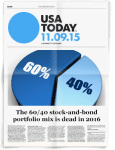
The 60/40 stock-and-bond portfolio mix is dead in 2016

Years ago, managing your investment portfolio was pretty simple: Invest in 60% stocks and 40% bonds, and rebalance your assets once a year.

But financial advisers are increasingly moving away from this traditional model of asset allocation.

“Those were not terribly bad rules a generation ago, but they’re now not just outdated but downright dangerous,” says Scott Puritz, managing director of retirement services firm Rebalance in Bethesda, Md.

The two big reasons that clinging to the old 60/40 formula is a bad idea, Puritz says, are a combination of short- and long-term factors.

“There’s the historic low-interest-rate environment, but also the fact that people are living dramatically longer,” he says.

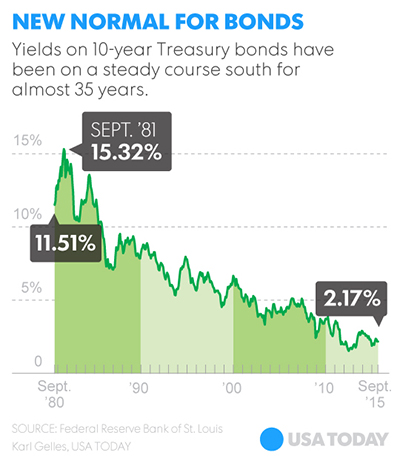
For context on just how low interest rates are, bond yields are currently “lower than 97% of history,” says Charlie Bilello, director of research for asset management firm Pension Partners. For instance, right now 10-year U.S. Treasury bonds yield less than 2.2% — which adds up to just $220 in a year’s return from a $10,000 investment. That’s down from about 5% yields right before the Great Recession, and yields on the 10-year that regularly approached 7% across the 1990s.

As for Americans living longer, the average life expectancy is up to about 79 years old and climbing thanks to modern medicine. That means if you quit working at age 60, you must have the savings to support your family for at least 20 years.

new-normal-bonds-xs

What’s the Right Mix for You in 2016?

Of course, there is no magic number that fits every portfolio. Even when the 60/40 rule was in fashion, it was just a rule of thumb to help investors get started on the right track.

So it’s not surprising that even when experts agree that the old guidelines are imperfect, they differ greatly on what the proper mix is.

For starters, Puritz recommends broadening the definition of “bonds” to include other income-producing investments, including high-quality dividend stocks.

“Would you rather have the AT&T dividend yield, which has historically been at about 5% and growing at about 5% a year,” he asks, “or would you prefer to have the AT&T bonds, which are at only about 2% and change?”

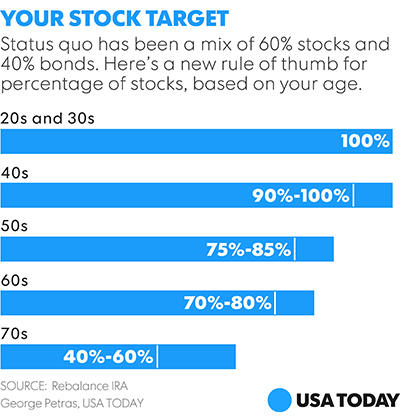
Beyond that, Puritz and Rebalance recommend a much more substantive allocation to stocks across all age groups and risk tolerances. Here is the percentage of stocks they recommend:

“That’s considerably higher than the previous norm,” Puritz admits, but plenty of historical data shows that it is exceedingly rare for the stock market to post a loss across 10-year periods, and that even these are short-lived. Looking out a bit longer, the market at large has never lost money over any consecutive 20-year period.

Therefore, Puritz says, someone in their 50s and even their 60s should have plenty of exposure to stocks as they focus on growth over the long term and not the risk of short-term losses.

“The biggest risk you face is not that the equity portion of your portfolio is going to bounce around 10%, 15% or even 20% in a short-term cycle,” he said. “If your time horizon is more than 10 years, your biggest risk by far is that you’re going to outlive your money.”

bWD3xbf-xs

Consider International Investments, Too.

On the other hand, while Bilello admits that current bond yields are paltry and Americans are, indeed, living longer and are in need of growth, he cautions against just throwing money at U.S. stocks and hoping for the best.

After all, the old 60% stocks/40% bonds was fashionable at a time when there weren’t a lot of international opportunities. As such, seeking diversification and growth opportunities abroad should be a key part of any long-term investment strategy.

“The risk/reward is more favorable today outside the U.S., because U.S. returns have far outpaced the rest of the world over the past five years,” says Bilello, who thinks investors with lots of cash in American stocks may be disappointed going forward. Diversifying into international investments is not without its own risks, however, and he cautions that “investors may incur higher short-term volatility for this higher long-term expected return.”

Of course, these are all starting points, and your personal investment needs may vary greatly — not just based on your financial goals, but also based on your personal risk tolerance.

After all, an investor who isn’t comfortable investing big-time in overseas markets or being 100% in stocks may ultimately panic even if they understand intellectually why these higher-risk investments should pay off long-term.

“There’s no sense in creating the optimal asset allocation that works at an intellectual level if when the markets drop, the investor can’t sleep at night,” Puritz says. “Particularly, as people get older, have families and mortgages and are paying down debt, their financial situations get more complex, so it’s good to have a seasoned professional in the mix to strike the right balance for you personally.”

How to replace your income when you retire

Transcript:

Mr. Mibach: Welcome to the Four on 2. I’m Mike Mibach

Ms. Arnold: And I’m Keba Arnold. While stock markets rise and fall, today in our Money Monday segment we’re breaking down the recent market correction after that huge drop this summer and we’ll explain how it impacts your money. Today, we’re welcoming back Mitch Tuchman. He is the Managing Director of Rebalance. Mitch, thanks for being here with us.

Mr. Tuchman: Thanks for having me, Keba.

Ms. Arnold: The last time you were here was a scary time. It was late August, markets were down some 10%, there was a market correction, but now you are back with us today to say things are “back to normal” as you call it. It was quite a ride.

Mr. Tuchman: Well, let’s say that the S&P is back to where it began the year. I don’t know what “normal” is, but drops in the stock markets, or “corrections” as they are called are definitely to be expected. We’re back to normal in the sense that the market has recovered, kind of, on schedule.

Ms. Arnold: So Mitch what lessons did we learn when it comes to our retirement account—you know, when you start seeing those numbers drop you think, “Oh my gosh, what should I do” and you want to hold on to your money. What lessons did we learn?

Mr. Tuchman: I think the main lesson people need to learn is that these corrections are like weather. Like your weatherman just reported, we have storms. It happens. You can’t panic, like I said to you on the show when I was last on and we were talking about this during the stock market fall.

Ms. Arnold: Right, you did say that.

Mr. Tuchman:
You can’t panic; the reason is that it is a normal pattern for the stock markets. If you do react to it by trying to get out, you are really going to cause yourself a lot of heartburn down the road.

Ms. Arnold: Mitch, what are some takeaways—you know when do you pay attention and when do you ignore?

Mr. Tuchman:
The key is that you need to have a retirement portfolio that allows you to pay no attention to corrections. You need your investment portfolio to be set up so you don’t think about it and that’s part of the key. If you have a lot of risky things going on in your portfolio, like owning individual stocks or owning expensive risky funds, then you are going to worry when you have a correction, because you may not recover. At my firm, Rebalance retirement investment portfolios are built like all weather vehicles so we don’t really worry about market corrections. There is a lot of reason to worry, if you are not prepared for these occurrences.

Ms. Arnold: So, it is having it set up a certain way to begin with?

Mr. Tuchman: Right.

Ms. Arnold: And if you need that help, either what, contact a financial advisor or try to figure it out online?

Mr. Tuchman: Right, but here is the key, stock market corrections happen every couple of years. In the last 65 years they have occurred in half of those years. A correction means that from the height, the market goes down by greater than 10%. It usually takes about 7 months to correct, but you just can’t respond to them. You just have to ride them out. The stock markets move so fast, like in the last 20 years if you missed the biggest 30 day moves in the market instead of getting a 9% return you got under 1% – you can’t try to do this in a timing fashion.

Ms. Arnold: So, but Mitch what happens, I get it if you are still young in your 20s, 30s or even 40s, what if you are closer to retirement (late 50s or 60s) and you are seeing these corrections happen should you respond differently depending on where you are at towards retirement?

Mr. Tuchman: Yeah, of course, they always say, “Put some more bonds in the portfolio”, but that’s more about emotion. See the thing people forget about is …

Ms. Arnold: It’s hard not to be emotional right, it’s your money, your retirement.

Mr. Tuchman: Well, the reason people who are older tend to relax a lot about this is that they have ridden these stock market ups and downs a few times, so they know you don’t have to worry about it.

Ms. Arnold:
True, good point.

Mr. Tuchman:
And you haven’t lost money. If you own the entire U.S. stock market through an index fund – a low-cost index fund – then you are really saying is the U.S. falling apart? If the U.S. is worth 5% less this week than it was 2 weeks ago have you lost 5%? If your house is down because we’re in a recession, have you lost money on your house? No, it’s just the evenflow of the markets.

Ms. Arnold: It’s the evenflow, don’t be emotional, make sure your portfolio is balanced?

Mr. Tuchman: Yeah and don’t own stocks. I suggest all retirement investments begin with big index funds. Index funds own all of the stocks in the market and that’s how you protect yourself because the U.S. economy has never fallen off on a correction and never recovered. The U.S. economy always recovers.

Ms. Arnold: Right. Mitch Tuchman, Managing Director of Rebalance. Mitch, thank you.

Mr. Tuchman: Thanks, Keba.

Roll over your 401(k) to a lower cost IRA for retirement

Transcript:

Corey: Mr. Tuchman joins us right now. He’s a partner at Rebalance – interesting business there. Mitch, what’s the problem that you guys are trying to solve?

Mitch: Well, we find that lots of people who are over 45 years old and have some money to invest in their retirement savings – particularly what we call “mass affluent,” people with $100,000 and maybe $500,000 – are trying to seek great advice. They end up finding someone they trust, a retirement broker or brokerage firm, and often times end up paying over a third of all of the expected returns of their investments in fees, and they have no idea this is happening. The fees are hidden, and they are essential when working with a commissioned salesperson. At the end of the day they are not going to retire with as much money.

Carol: A lot of folks though are doing this through their company-sponsored 401(k) plans. So, what about the responsibility there or the transparency there?

Mitch: So, that’s generally pretty good because 401(k) or 403(b) plans sponsored by an employer operate under what we call a fiduciary standard, meaning employees can sue their employers if they are not doing things for the plan that are in their best interest. However, if you work for a smaller company, the retirement investing plans tend to get loaded with fees. The problem is once you leave the company, you have to do what’s called a rollover, that is move the money into an IRA. Once the money gets into an IRA, all hell breaks loose. That’s when the retirement brokers come and feast on people’s accounts. Ultimately, all of your money ends up in an IRA as you move the money out of past employer-sponsored plans and you’re on your own, come retirement. And the statistics show that the returns on those IRAs suffer.

Corey: Interesting. You know, we were at a Fidelity trader conference this week in Los Angeles, and I thought one of the interesting takeaways was over the lifetime of an investor putting money away there are different services that they want — this is Fidelity’s notion — different services they want from the investment company. That at a certain point they want to be able to see their stuff online. They might want to make the decisions about what they do online. They might even want this sort of “robo advisor” advice, but at certain important touch points they either want to call people and maybe they want to sit down with somebody and talk about their retirement. So I’m curious what your description of the time when someone sits down with someone they trust and how that is lacking in the robo-advisor business, which we know is maybe a great threat to some of the big institutions out there.

Mitch: In our business at Rebalance, we find there are two kinds of people. Not to generalize, but there are certain people who would never, ever hand their retirement accounts over to someone else to manage. They just would never do it. They like to manage it themselves, they like to pick funds and stocks. So, I’m not talking about those people. I’m talking about the other people who are hungry to have someone else handle their retirement accounts. They have anxiety and stress about what to do with their money, so they are desperately seeking someone they can trust. They don’t enjoy retirement investing. They don’t know anything about it. They don’t have time for it. So they want to give it to somebody.

Carol: And this goes back to your fiduciary standard, that this is potentially where were are kind of moving towards, correct? I know you guys have been pretty vocal and your team has been pretty vocal about this.

Mitch: Yes, as people get older and accumulate more money, the more complicated their financial situation becomes. So, if you are under 35 and you have saved up $20,000, $30,000, $50,000, a robo solution is great. You probably don’t need to talk to anybody, and an algorithm can make these decisions for you. Our market at Rebalance is typically over 45 years old. They’ve saved up $100,000, up to $500,000, and they have a complex situation.

Carol: We got 30 seconds left here Mitch, so in terms of the fiduciary standard it’s not quite in place yet correct, but it could be.

Mitch: We think it will be, absolutely, and hope so.

Carol: And you think in terms of fees and transparency for those folks who have a certain amount of money and are looking for help it will give them a better situation, especially when it comes to the fees that they are charged and so on and so forth?

Mitch: It’s really simple —if these consumer protections get passed, no stock broker will be allowed to sell without fully disclosing all of the fees and any built-in conflicts of interest on the part of the stock broker.

Carol: All right, interesting and I know it is a situation we monitor here at Bloomberg. Mitch Tuchman, managing partner at Rebalance, and his team work with clients nationwide. You are listening to the Bloomberg Advantage. Carol Masser along with Corey Johnson right here on Bloomberg Radio.

High fee retirement investments cost you a third of your savings

Transcript:

The first thing to realize about financial advice is that it’s not free — and it often costs more than you think. That’s what Morra Aarons-Mele found when she decided to find a financial adviser after she inherited an IRA from her father.

“I felt like I wanted an adviser because I was uncertain about — I never had any money before, frankly, and I really wanted to be a good steward of it,” Aarons-Mele says.

She found an adviser who charged her a yearly fee of 1 percent of the value of the IRA. That’s pretty standard. But after receiving some quarterly reports, she started feeling uneasy about all the added fees.

“The fees were all over the place, so that even though my fee that I had agreed with my adviser seemed completely reasonable — obviously I wanted her to be able to earn a living,” she says, “it was that there seemed to be all these hidden fees in various funds.”

So in addition to paying her adviser 1 percent a year, Aarons-Mele was paying a lot to the managers of the mutual funds in her portfolio. The average U.S. mutual fund charges just under 1 percent in fees. That may sound like small change, but the impact can be truly dramatic.

Over 30 years, paying 1 percent annually for advice and another 1 percent for your mutual funds could cut your retirement gains almost in half.

So keeping fees much lower than average is critical, says Kate Fries, a retirement adviser at The Family Firm based in Bethesda, Md. Fries also charges 1 percent for her advice, but she’s all about keeping the other fees to a minimum.

“The vast majority of the time, whether in an index fund or even more inexpensively via an ETF [exchange-traded fund], it should be well under a half a percent,” Fries says.

An ETF is a basket of stocks traded like a single stock in the stock market.

Often, investors pay too much in fees because their advisers get commissions from a mutual fund company to steer business to their high-fee products. But Fries is a fiduciary, which means she is required to put her clients’ interests first. (That’s something you should insist on when you seek financial advice.)

Of course, even paying close to 1.5 percent could cut significantly into your investment returns, so why not just invest on your own or in one of those cheap robo-advisers online?

Fries argues it can be worth it to pay for a human adviser. She says they can help you work through how to organize your finances to achieve your goals, and when you’re ready, how to structure your retirement. And, she says, she protects her clients from themselves.

“It’s really hard when the market is as volatile as it was this past August and to not knee-jerk react and decide, ‘Oh, gosh, is now the time to sell? I don’t want to lose everything,’ ” Fries says.

But here’s the problem for the vast majority of Americans: They don’t have enough money to access Fries’ advice. Her firm requires a $600,000 minimum investment.

There is a new model for providing less expensive advice being offered by a number of firms. An innovative firm called Rebalance uses a hybrid model that keeps costs low by combining human advisers on the phone and technology online.

“Rebalance charges a half of 1 percent for retirement investment advice for our clients,” says Scott Puritz, a managing director for the firm.

That’s half the cost of a traditional investment adviser. And Rebalance builds investment portfolios of index funds and ETFs that add just 0.2 percent to the fee.

“So our clients experience an all-in, comprehensive cost of 0.7 percent per year,” Puritz says.

But Rebalance’s minimum investment is $100,000, and Vanguard’s similar service requires a $50,000 minimum.

That still excludes the majority of Americans. To fill that gap, a new network of financial planners has sprung up. It’s called the XY Planning Network. Cristina Guglielmetti of Future Perfect Planning is one of them.

“We are all planners who are trying to deliver quality fiduciary financial planning services to clients who have traditionally been cut out of financial planning,” Guglielmetti says.

Her clients are often younger people — freelancers, new parents and newlyweds merging their finances. Guglielmetti charges them $500 for an initial plan and about $100 a month to help them define goals, track expenses and begin investing for retirement. And like some other planners in her network and elsewhere, she’ll work for an hourly fee.

Investing May Be Cheaper, but Fees Still Hurt

Mutual fund expenses can take a big bite out of shareholders’ returns. That bite, on average, is shrinking, but academic and industry experts say it could — even should — be diminishing faster: Plenty of investment companies still charge a lot, and many consumers still opt for pricey funds.

Morningstar, the investment research company, and the Investment Company Institute, an industry group, both track mutual fund expenses. Their data, while differing slightly, tells the same tale: Investing in mutual funds is getting cheaper. And that means many investors can keep more of their return dollars.

“The only thing I’m sure about in investing is the lower the fee I pay, the more there’s going to be for me,” said Burton G. Malkiel, a professor emeritus of economics at Princeton University and the author of the well-known investment primer “A Random Walk Down Wall Street.” “Fees have come down, on average, because fees for index funds are so much lower than active funds, and people have moved to them.”

The measurement of fund expenses is a little technical, but it’s worth understanding. Fees are usually expressed as a ratio of expenses divided by fund assets. That number is called the mutual fund expense ratio.

Morningstar, in its 2015 fee study, reported that the asset-weighted average expense ratio for all funds was 0.64 percent last year, down 15 percent from five years earlier. Someone who invested $10,000 in a fund with that expense ratio would pay $64 a year in expenses. Thus, if her fund returned 5 percent, or $500, in the first year, she would pocket $436.

The asset-weighted average includes fund size in the calculations as opposed to equally counting everything from monsters like Fidelity’s Contrafund, with $103 billion in assets, to minis like Bridgeway’s Ultra-Small Company fund, with $128 million in assets. With asset-weighting, a big fund like Contra affects the overall average expense ratio more than a smaller fund like Ultra-Small.

When you cut through the complexities, it’s clear that the fund industry hasn’t gone the way of Walmart in its pricing. Rather, as Professor Malkiel suggested, many investors’ preference for cheaper fare is dragging down the average. Consider the popularity of the Vanguard 500 index fund — one of the country’s largest funds — which charges 0.17 percent for its basic investor shares. Vanguard’s chunk of industry assets under management has grown to an industry-leading 19.2 percent, as people have moved into its funds, the Morningstar report said.

But falling expenses are “more than just a phenomenon of money going into a handful of low-cost providers,” said Brian Reid, chief economist for the Investment Company Institute. “Competition has driven many companies to offer lower-cost share classes.”

A generation ago, investors typically had a choice between lower-cost funds acquired directly from fund companies and higher-cost ones generally bought through financial advisers. Today, investors using financial advisers can also often buy lower-cost shares, which don’t carry the sales charges that the industry calls loads. Advisers typically charge their clients asset-management fees, and then purchase the cheaper shares on behalf of those clients.

“If you looked at funds that were broker-sold in 2000, about 50 percent had a no-load share class,” Mr. Reid said. “Now about 90 percent of them have a no-load share class.”

Fund companies are prospering anyway. Even with these kinds of changes, “industry fee revenue is at an all-time high, reaching $88 billion,” Morningstar said. Over the last decade, total assets under management have more than doubled, while fee revenue has grown by approximately 78 percent, the company said. Yet funds’ asset-weighted expense ratios declined by only 27 percent. “Thus a much larger share of the benefits of the increase in assets under management has stayed with the industry rather than being returned to fund shareholders,” Morningstar said.

On one level, that’s not surprising: Fund companies are typically motivated by profit, and their goal is to enrich their owners. (Vanguard, which is owned by fund shareholders, is an exception.)

Yet every mutual fund has its own board of directors, which has a fiduciary responsibility to serve the interests of the fund’s shareholders, not the investment company that sponsors it, said David M. Smith, a finance professor at the State University of New York at Albany. Fund boards “need to think much more seriously about expense ratios that they are authorizing,” he said.

“To me, this is one of the big disconnects in the industry,” he added. “Too often, fund boards of directors don’t seem to be looking out for the interests of the fund shareholders” when it comes to expenses, he said.

This disconnect can seem especially acute in sectors like emerging markets, where the total numbers of assets under management are smaller. The average emerging-markets stock fund has an expense ratio of 1.54 percent, according to Morningstar. Some funds charge even more. The A shares of the Templeton Developing Markets trust, which do not include a built-in sales charge, carry a net expense ratio of 1.68 percent, for example, and those of the Delaware Emerging Markets fund carry a ratio of 1.69 percent.

Compare that with Vanguard’s Emerging Markets Stock index fund, which carries an expense ratio of 0.33 percent, or with Fidelity’s actively managed Emerging Markets fund, which carries one of 1.07 percent.

Seemingly small differences can add up to major costs. An investment of $10,000 in a fund charging 0.33 percent and returning an annual average of 10 percent would be worth about $100,000 after 25 years, while the same investment in a fund charging 1.69 percent would be worth only about $70,000. That gap in fees becomes significant when it’s time to collect on the investment.

“How is it that some fund boards believe it costs twice as much to invest in emerging markets as it does in developed ones?” asked Russel Kinnel, Morningstar’s director of mutual fund research. “There’s a lot of company information out there, and you don’t need three analysts based in Tunisia.”

Fund companies can incur higher costs when they manage money in less liquid markets like emerging countries, and this is reflected in expense ratios, said Tim Cohen, a chief investment officer at Fidelity Investments. “We do look at where the rest of the market is priced” when setting expense ratios, he said.

If there is consensus about expenses among analysts and academics, it is that cheaper funds are likely to provide better returns to investors. For example, Morningstar has examined expense ratios repeatedly and found that, over the long term, the performance of cheap funds beats that of their costlier cousins.

“I’ve done studies that find that funds in the cheapest quintile of expense ratios are a much better bet than the rest of the fund world, even the second-cheapest quintile,” Mr. Kinnel said. “I have a lot of confidence in this finding, and one of the reasons I have so much confidence is that every time we study it, it has predictive value.”

In investing, as elsewhere in life, cheap is relative. Professor Malkiel said his benchmark for bargains in a fund category was whatever the cheapest index funds charged. Actively managed mutual funds, on average, don’t beat the market, he said. Thus the sensible path for retail investors is to accept the market’s returns, minus low expenses, that index funds can deliver, he said. “This wouldn’t hold if active funds were getting a higher post-fee return,” he said. “But the evidence is abundantly clear that they’re not.”

Not everyone wants to invest only in index funds, of course. Some investors enjoy the challenge of finding a fund that might beat the market. Others believe that active managers can succeed in less picked-over sectors or deliver market-matching returns with less risk.

Investors who opt for actively managed funds should seek those that have delivered a better-than-average return over three to five years than peer funds and have cheaper-than-average expense ratios, said Todd R. Rosenbluth, director of exchange-traded fund and mutual fund research at S&P Capital IQ.

“That way, the fees won’t weigh your returns down as much,” he said. “Actively managed equity funds have around a 1 percent expense ratio on average. So if you’re paying more than that, you may be paying too much.”

The $17 Billion Cost Of The Status Quo For America’s Retirement Savers

You can hardly blame an industry for defending the status quo when it allows them to rake in $17 billion a year in profits that would otherwise be off limits. But that narrow self-interest is by no means a compelling argument for the rest of us who lose those billions of dollars in the process.

Ronald Reagan once famously joked that “status quo” is Latin for the “the mess we are in.” A very clear case in point is the current debate in Washington, D.C. about requiring brokers to start putting the interests of their clients first.

The U.S. Department of Labor has proposed a “fiduciary rule” that would require all financial professionals to stop giving conflicted (i.e. self-serving) advice when it comes to retirement investments. The financial industry’s case against the rule boils down to this: It will make it more expensive and less profitable for them to provide advice to retirement savers so fewer people will be willing to provide it.

Experts dispute that, but there is no doubt that leaving things the way they are now is much more expensive for America’s millions of retirement savers.

Here’s the problem: Savers — small and large — often have to rely on advisers to understand their options regarding investing their retirement savings. Outdated Labor Department rules have allowed brokers, insurance agents, and others offering retirement investment advice to put their own interests ahead of their clients’ best interest. Such investments generate handsome commissions for them but saddle innocent clients with high fees and poor returns. The annual cost of conflicted investment advice is estimated to be $17 billion – money that is going from the retirement accounts of average Americans and into the pockets of financial professionals.

The end result of all that conflicted advice is that millions of Americans end up with smaller nest eggs for their golden years. They will run out of money sooner or be able to do less in retirement … or both. Some unfortunate savers end up losing much, or even all, of their nest egg when conflicted advice puts them in inappropriately risky investments with high fees. The situation is made much worse when brokers, insurance agents and others try to pass themselves off as investment advisors, who are required to honor a “fiduciary duty” to their clients.

The good news is that the Labor Department’s proposed rule change tackles the problem head on, requiring anyone giving retirement investment advice to act in the best interest of their clients and comply with what’s known as their fiduciary duty. But brokers and others in the financial industry are fighting hard against the rule to preserve their old way of doing business—and the hefty fees they can earn at the expense of their clients. One of their main talking points is that the rule will actually hurt everyday investors – especially middle income savers – by making it unprofitable for brokers to offer advice to modest account holders under the best interest standard.

The truth is that many U.S brokerage firms in the U.S. are designed to harvest maximum profit. It should come as no surprise that their business model won’t work in a world where they have to put the interests of retirement savers first. But that doesn’t mean that there are not good options available today for individuals who want help.

Using technology-based platforms, a new generation of firms is now offering retirement investment advice to clients all across the income spectrum for very modest fees. They include Wealthfront, and our firm, Rebalance, among others. This new generation of tech-driven advisory services is finding ways for retirement savers to lower their investment costs.

What’s driving this evolution in the retirement financial advice industry?

It’s fairly simple. By harnessing efficient modern technology to cut costs by over 50%, the new generation of advisory services has discovered that it is possible to do the right thing by their clients and still run a profitable company. In fact, we’ve seen many savers reach out to us for help after working with a broker-dealer, paying high fees, and ending up with little to show in returns on their retirement investments.

It’s time to hold all financial professionals accountable by consistently requiring them to act in the best interests of their clients. That’s what the DOL rule can do. Americans struggling to save for a dignified retirement should no longer be subjected to the conflicts of interest that are bleeding off their savings. And, if traditional brokerage firms can’t live with the simple fiduciary standard and refuse to serve modest savers, so be it. Other financial professionals on and off the Web who embrace the client-first approach stand ready to help all Americans prepare for a secure retirement.

We can do better than a status quo that imposes a “tax” of $17 billion per year on American retirees. We don’t have to settle for “the mess we are in” when it comes to the financial wellbeing of the retirement savers of America.

Dr. Ellis is the former Chairman of the Yale Endowment Investment Committee, and Mr. Puritz is the Managing Director of Rebalance-IRA, a technology-enhanced national investment service.

How a new rule will save millions for American retirees

To see Rebalance’s Managing Director, Scott Puritz testify, go to 08:37.

Speaker: … and you tell me if you think they’re workable and if you think they are not workable, tell me why they’re not workable.

Speaker 2: Recently, the U.S. Department of Labor held hearings on new rules that require financial advisors to act in the best interest of their clients and to disclose the real cost of the investments they recommend.

Speaker: You know, a commitment that when your reps are giving advice to people that that advice isn’t going to be affected by their financial incentives but just going to be what’s in the interest of the customer.

Speaker 2: Managing Director of Rebalance, Scott Puritz, is a nationally recognized authority on retirement investing and was invited to provide expert testimony.

Mr. Puritz: The marketplace is not working. It just categorically is not working. There is not true awareness of the multi-layer of fees. We surveyed our clients who had come over from brokerage relationships, and 83% of them had no idea of the second level of fees.

Speaker: Also invited was Ron Kruszewski, CEO of Stifel Financial, a 125-year-old brokerage house that opposes the new rule. Puritz and Kruszewski squared off.

Mr. Kruszewski: And to the extent that the market supports a business model like yours, I’m all for you.

Mr. Puritz: How about a regulatory level playing field, what’s wrong with that?

Mr. Kruszewski: We have one.

Mr. Puritz: No we don’t. That’s just absurd.

Speaker 3: Can you elaborate? What’s not level about the playing field?

Mr. Puritz: A completely different set of standards. “Best interest” is not a fiduciary standard.

Speaker: Under current rules, brokers are not required to disclose the fees they charge. Even small fees add up and compound over time, and may compromise an investor’s ability to retire with a comfortable nest egg.

Mr. Puritz: Albert Einstein is to said to have described compound interest as the most powerful force in the universe, but long-term compounding is a double-edged sword. Fees also compound and unnecessarily eat away of retirement savings. In the case of our client Moira, by the time she retires this extra $5,000 in annual fees would have compounded potentially to over $500,000 of extra fees. For many Americans, this extra retirement investment fee burden is the difference between retirement investment security and having to take on a part-time job late in life.

Speaker: The Department of Labor’s new rule is designed to save investors billions of dollars they lose each year due to conflicted investment advice and hidden fees.

Mr. Puritz: Well, there’s one level of fees that are disclosed, if you will, or the consumer seems to be aware of, the classic 1%, 1.5% or some different configuration, but where there is almost always a lack of awareness is at the fund level, where there are actively managed mutual funds that are frequently recommended, and that’s the missing piece in the marketplace.

Speaker: One way to avoid that risk right now is to make sure that your advisor is a registered fiduciary. To find out more, go www.rebalance-ira.com.

Stock broker fees take up to a third of your retirement savings

The old guard, Ron Kruszewski, CEO of Stifel Financial, a 125-year-old brokerage house in St. Louis, Mo., and the new guard, Scott Puritz, Managing Director of Rebalance, a robo advisory firm, sparred yesterday in the latest round of the fight over a newly proposed Department of Labor fiduciary rule aimed to protect retirement investors from conflicted advice. Their banter provides a snapshot into the complexities of a rulemaking that’s been five years in the making so far.

Is there room for both fee-based advisory and commission-based models under the proposed rules?

“We do not want to make the broker model impossible,” said Timothy Hauser, the DOL deputy assistant who led four-days of public hearings this week. “We agree not everybody needs an ongoing advisory relationship…. We just want to tamp down on conflicts.”

Kruszewski said the proposed rules would force his firm to migrate its commission-based clients who pay 50 basis points on average in annual fees to the firm’s more expensive advisory model where clients pay 107 basis points on average. “If we move brokerage accounts to non-conflicted advisory accounts, we will double what we will charge them; I think that’s lost in this discussion,” he said.

Puritz countered that retirement investors have a better option, signing up with investment innovators known as robo-advisors. He pitched his firm as well as Bill Harris’ Personal Capital; Vanguard and Schwab have similar offerings (Rebalance charges a flat 50 basis points annual fee for an endowment-style portfolio).

“Brokerage refugees” are seeking out the new model—for example, after learning that a “trusted retirement advisor” never disclosed extra fund level fees nor the fact that he did not have a fiduciary duty to put clients’ interests first, Puritz said. A common sales pitch: For one woman, her late dad’s broker recommended a new actively-managed mutual fund with a front-end load of 5% off the top. She was paying more than 3% in annual fees. Consider: A 1% extra annual fee can eat up 20% of your eventual retirement nest egg and reduce your retirement income by more than a third, according to the Center for Retirement Research at Boston College. For many, this is the difference between a sound retirement or not, Puritz said.

The problem the DOL is attempting to address is that current rules (issued in 1975) don’t ensure that all financial advisors act in the best interest of investors. It’s a real problem and a big problem: today the assets in 401(k) plans and Individual Retirement Accounts (under the regulatory purview of the DOL) exceed $14 trillion. Conflicted advice in these accounts tallies up to billions of dollars of investor losses, the DOL says.

Pretty much everyone professes to agree that a “best interest standard” is the goal but there are many ways to get there and many moving parts: disclosures, contracts, and exemptions. The DOL has been working on rules for five years.

In the meantime, it’s up to consumers to do their due diligence on fees, conflicts and whether their advisor (or that advisor’s firm) is getting ongoing commissions. If a financial advisor is a fiduciary, they are required to put the best interest of the client first. Brokers and insurance agents are usually held to a lesser standard—only that the investments they recommend be “suitable” for the client.

Still Kruszewski gave an example of how brokerage accounts work well for a retiree with a laddered bond portfolio in an IRA, for example. “If I have a bond account with $200,000, should I bring it to your firm?” Kruszewski asked Puritz. “No,” Puritz admitted. “It would be unsuitable,” Kruszewski said, adding that millions of investors are adequately served by the brokerage model.

“Our core philosophy is full and fair disclosure; we’re just not seeing that out of the brokerage community,” countered Puritz.

“I think the market is fair,” retorted Kruszewski, adding, “”If our brokerage clients want to look at your business model, they can.” (The pair shook hands and smiled on this point.)

Hauser closed the hearings thanking everyone who participated, including those who submitted comments, and called for more. “We are taking all of your comments into account, and you’ll see that it will make a difference,” he said. An archive of the public hearing webcasts and comments (2,606 and counting) are available here. The Kruszewski-Puritz panel was #21 out of 25 panels (a full agenda is here). Stifel Financial’s comments are here.

Avoid retirement mistakes using this checklist

Transcript

Mike Hydeck: Welcome back.  Some hidden fees could be eroding your savings for retirement and that could have a dramatic impact on your future.  Here now is Scott Puritz.  He’s Managing Director of Rebalance. Scott it’s so nice to meet you, thanks for coming in.  First and foremost we were just talking during the break, we do so many stories on banks and hidden fees and they get caught and they have to pay fines.  These fees are obscure to find when you read your balance sheet, how can you find them in your retirement account?

Scott Puritz: Well those are hard, but they’re very, very common. The easiest thing is really just to switch to low-cost index funds, which are really the way to go.

Mike Hydeck: For a lot of us, it’s financial jargon that we can’t decipher, which means it’s obscure on purpose and the fees could be hidden within that jargon it seems. Am I correct on that, and what do we do?

Scott Puritz: You’re absolutely correct, and there is an initiative right now with the Department of Labor to make retirement investing safer for all Americans, and really eliminate these conflicts of interest, which lead to the hidden fees and obscuration.  What consumers can do is migrate to low-cost index funds.

Mike Hydeck: How can you choose?  You go online to any financial site and there may be thousands to choose from, how do you know what’s going to have low fee?  How do you find it?

Scott Puritz: Well one of the safest names is Vanguard. They are a non-profit, they invented the low-cost index fund, and pretty much all of their products are low-cost and very well run and they have a whole family of index funds.

Mike Hydeck: Now you have some tips that you gave us ahead of time.  One of them you said is to take the emotion out of it and keep the fees low.  You’re saying that Vanguard is one of the choices that you can try to investigate to learn more.  What are some of the others?

Scott Puritz: Keep it simple, Mike.  For good retirement investing, all a person needs are two funds – a low-cost stock fund and a low-cost bond fund.  We’ve all be subject to commission-based financial salesman, trying to push certain products and annuities.  Keep it simple. 

Mike Hydeck: What do you think the likelihood is of this legislation moving forward in Congress to try to make it a little bit simpler and bit more clear for investors and retirees?

Scott Puritz: The people who I trust, who know these things a lot better than I do, say that it’s highly likely to get passed and implemented by year’s end.

Mike Hydeck: And that could mean substantial savings when it comes to fees over time I would imagine.

Scott Puritz: A lot more transparency, and if not elimination then dramatic reduction of conflict of interests in financial services.

Mike Hydeck: Some reports that I have read said that you could lose up to 1% of your retirement nest egg by not being careful about fees.  Does that sound right?

Scott Puritz: It’s much higher than that.  Hidden fees can eat up to one-third of your investment benefit over twenty years.

Mike Hydeck: Keep it simple.   Look for the lost-cost funds.  Scott we appreciate your time.

Scott Puritz: Thank you Mike.