
Washington Post Icon

Scott Puritz has been around money for most of his 62 years, so he knows something about the subject. He comes from a family of entrepreneurs. He attended Harvard Business School. He loves researching, discussing and creating able enterprises.

The enterprises he’s built include a profitable cake-delivery company in college (it still exists) to one of the biggest data centers in South America.

“I helped bring the cloud to Brazil,” he said.

Puritz’s new thing is low-cost, minimum-risk investing — a philosophy I heartily endorse (along with saving and living beneath your means). But I don’t recommend (or disapprove of) specific funds, stocks or financial advisers for this column.

Puritz and his business partner are putting their financial IQs to work advising middle-income savers how not to blow their nest eggs. They are doing it through a firm called Rebalance that is disrupting the staid world of boutique investing and stock picking by putting (almost) everything in the cloud.

Its conceit is long-term, low-cost indexing, mostly through Vanguard Group’s exchange traded funds (ETF). (I have been a client of Vanguard for decades but do not own an ETF. I have index and managed funds.)

“One of the most shocking things is the low-level financial literacy throughout our culture,” Puritz said. “It’s independent of education. Doctors, MBAs, corporate executives are in­cred­ibly competent in everything they do. But when it comes to investing, you run into this cauldron of mostly negative emotions, embarrassment, frustration, guilt. It leads to paralysis.”

Rebalance’s 745 clients have total assets of $425 million. The average client has about $571,000 in savings. Rebalance accepts clients with both retirement and taxable savings. It serves a handful of $10 million clients.

Here is how it works: A potential client goes online to schedule a time with a Rebalance financial adviser. In the initial 45-minute consultation, the company asks a series of questions to determine the person’s goals and risk tolerance. The adviser follows up within 24 hours to the prospective client with a recommendation of one of Rebalance’s seven portfolios.

If the person decides, after subsequent conversations, to become a client, the company works with them to consolidate the client’s retirement assets — as painlessly as possible — into one account. At that time, the client pays a one-time $250 fee to Rebalance. Rebalance accepts only clients with at least $100,000 to invest.

Once the client is on board, they can stay in touch with the Rebalance team as often as they like. Once a client is married to a specific fund, that investment is on auto­pilot until the annual checkup that each client receives. Clients can also get in touch by telephone.

“Our front-line people are financial therapists,” Puritz said. “They need to be empathetic. People are very emotional about their money.”

Puritz said he and his business partner, Mitch Tuchman, charge a 0.50 percent fee on total assets, which is deducted from their accounts on a quarterly basis, a standard industry practice.
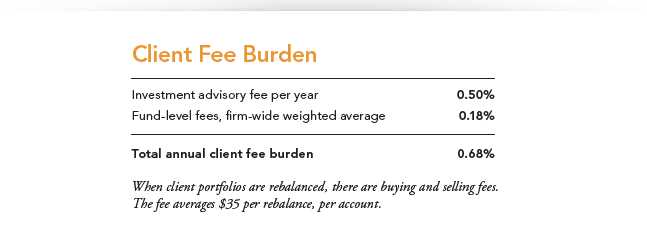
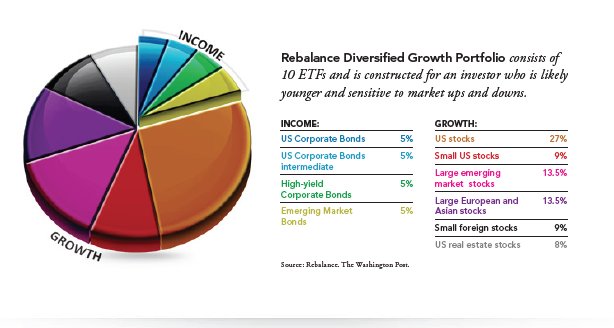
That means a $100,000 savings pot will cost you $500 a year for their expertise. But that’s not all. There are fees on the ETFs that average less than 0.20 percent that are included in the price of the index fund, which is also standard industry practice.

There are also a couple of modest transaction fees during the year that come to about $70 total. Those fees — as well as the name Rebalance — come from the twice-a-year fine-tuning of the portfolio to ensure its percentages stay consistent with the client’s stomach for risk.

That means that for a $100,000 account, the all-in annual cost averages a bit less than $800.

Here’s what my wife and I do: We have a financial adviser who charges an annual flat fee. The service is different from Rebalance, which sticks only to investing. Our adviser offers broader advice on things such as mortgages, insurance, employee benefits, long-term care and taxes. But he visits us twice a year, and presents a list of our holdings and whether the percentages are in line with our own risk tolerance, similar to what Rebalance does.

Puritz and his partner make money. The firm has 20 employees, earns around $3 million a year in revenue, and is co-anchored in Bethesda and in Palo Alto, Calif., where co-founder Tuchman, a contributor to digital site MarketWatch, lives. Puritz lives in Montgomery County.

The two Harvard graduates have signed up three brand names from the investment world to sit on their investment committee, adding gravitas, expertise and marketing value.

The committee includes Burton Malkiel (“A Random Walk Down Wall Street”) and Charles Ellis (“Winning the Loser’s Game”), considered two of the “godfathers” of indexing investment. It also includes Jay Vivian, who oversaw $100 billion in investments as managing director of IBM’s Retirement Funds. Each has an ownership stake in Rebalance for their efforts.

Rebalance is consistent with everything that I have believed throughout my professional life,” Malkiel said in a phone interview. “I was the guy in 1973 who said you’d be much better off with an index fund.”

Puritz and Tuchman have used technology right from the start, spending a year working with Salesforce.com to build a cloud-based business platform that put everything, you guessed it, in the cloud. They have eliminated paper and the administrative costs that go with it. Many of Rebalances advisers are men and women who left finance careers to raise children.

For the most part, “there is no ‘mommy track’ in personal finance,” Puritz said. “You find real, high-quality men and women who left the finance business and started families. We found if we can offer them part-time, flexible hours, we can get some very high-quality advisers.”

Its niche is people ages 45 to 65 with about $450,000 to $1 million in investable assets. That’s too small for many traditional wealth advisers, but it fits nicely with Rebalance.

“That’s our sweet spot,” Puritz said, adding that the company was profitable a year after it was started in 2012.
Puritz’s father and grandfather were both businessmen. His grandfather owned a high-end women’s store in Ridgewood, N.J., and his father followed in his footsteps, sort of, founding a successful, high-end men’s clothing store.

“I always thought I was going to be entrepreneurial,” said Puritz, 62. He traces it to “watching my grandfather and my father, and my mother, who started her own real estate brokerage.”

Puritz attended Tufts University, where after only a few months he launched a “snack pak” business allowing parents to send their kids candy and stuff to power them through their first exams. He persuaded the administration to give him a mailing list of home addresses and then sent them letters just before Thanksgiving.

“I made thousands of dollars,” he said.

He launched a similar business based on birthday cakes, working out a wholesale deal with a local bakery and delivering the cakes around campus himself. He sold that for several thousand dollars, and has been building businesses ever since.

He made his money disrupting South America’s traditional telephone business. The United States had been a few years ahead of Latin America in the dissolution of traditional, analog communications in favor of wireless and fiber-optic systems.

Puritz had a window into the industry from some consulting work he had done after Harvard, and saw vacuums that could be filled with new products. He did it with names such as Radio Movil Digital, Diveo and OptiGlobe, which brought the first data centers to Buenos Aires.

By 2002, he was finished and living on his telecom profits in Montgomery County.

Tuchman had a long career in finance and investing, and he and Puritz occasionally jawed about starting a business together starting back in business school.

About 15 years ago, Tuchman had a payday from a Silicon Valley company that had what the venture capital set refers to as a “liquidity event.”

Tuchman wanted to invest money on behalf of his family. He immersed himself in the world of modern portfolio theory, as practiced by Malkiel, Ellis and others.

Tuchman launched MarketRiders, the first online “robo” investing tool. He soon began strategizing with Puritz, and saw broader business possibilities. They joined forces and launched Rebalance to concentrate on investing for others.

“I said, ‘Mitch, this is a great business,’ ” Puritz recalled.

They had a handshake deal by January 2012, but there were challenges. The money management field was hugely competitive. How do we set ourselves apart?

Tuchman wrote an email to Ellis, and the investment icon was receptive to participating.

Tuchman jumped on the Amtrak train in Washington, and met Ellis for breakfast the next day. This led to Malkiel and to Vivian. And a business was born.

Thomas Heath is a local business reporter and columnist, writing about entrepreneurs and various companies big and small in the Washington metropolitan area. Previously, he wrote about the business of sports for The Washington Post’s sports section for most of a decade.

This article was originally published in The Washington Post on July 6, 2018.

Rebalance firm clarification: As of 7/9/18, the firm manages $630,000,000 and over 1,300 accounts.


Financial Management

It is a scenario that is all too common. Widows and widowers can find themselves treading water when it comes to financial management after the death of a loved one. 7 On Your Side’s Michael Finney looks at how “adult kids” can help their grieving parent get through this tough time.

San Francisco resident Charlene Tuchman is still getting used to life without her husband, Sidney, one year after his death.

They were married for 62 years. “He was fun. He was a little bit outrageous, he was sweet. He was kind,” she said.

Sidney ran a big dry-cleaning business in Indianapolis and took care of all the finances at home. “When it came to things like insurance, investments, and building the funds and money, I seriously had absolutely no idea,” Charlene said.

Her son happens to be a managing director of the Palo Alto-based retirement investment management company Rebalance. Mitch Tuchman says the firm works with a lot of people who are widowed or divorced from spouses who made the financial management decisions for them. “It’s very stressful, and money powers one’s life generally, so when you don’t have that control, it’s very scary for people,” said Tuchman.

He sat down with his mother to ease her fears.

Check out the rest of this piece on ABC 7 News.

Most people need financial advice at some point. But before making a deal with a financial adviser, people should know precisely what they’re paying—and what they’re paying for.

Unfortunately, that isn’t always easy. Advisers offer a range of services and fee structures, and a lot of clients can feel intimidated by both the jargon and the concepts. But if people don’t get the relationship with an adviser right at the beginning, the mistake could be compounded over years—and that can end up costing them hundreds of thousands of dollars over a lifetime.

Many advisers, for instance, offer a lot fewer services than others—but charge the same fees. Some don’t spell out in advance that clients may end up doling out additional fees each year for investments such as mutual funds.

And it may end up being a better deal for some investors to opt for a bare-bones service that just manages investments and doesn’t offer other advice. That’s especially true now that people can’t deduct certain investment management fees under the new tax law. With that in mind, here are six key questions to ask an adviser.

1. Of the fee arrangements you offer, which one best suits my needs?

It’s a basic question, and one too many people don’t ask—in part because it requires clients to figure out what their needs are in the first place.

The most-expensive option is a soup-to-nuts package that involves not only money management—taking care of all tasks like investing and rebalancing a portfolio—but also financial planning (for instance, helping clients figuring out the best way to save for college or retirement). What’s more, people with a very high net worth, perhaps $10 million or more, might have the option to have the adviser handle day-to-day financial chores like paying bills and banking.

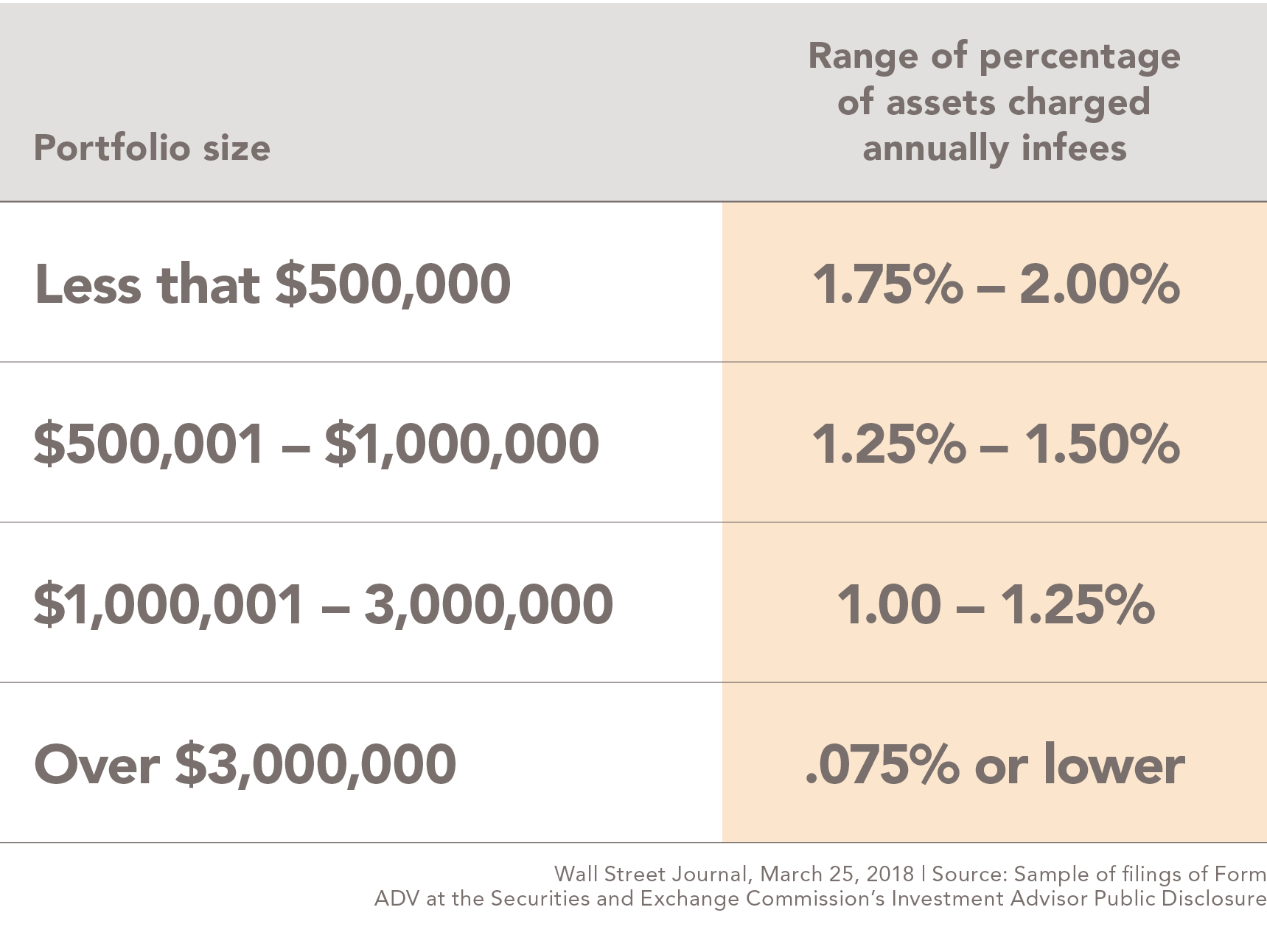
For all that, people pay a percentage of their assets under management each year. The more assets, the lower the percentage: Someone with $1 million will likely pay 1% to 1.25% annually, while someone with $500,000 or less could pay 2%.


People who don’t want all that help might find that other arrangements work better, says Michael Kitces, who heads wealth management at Pinnacle Advisory Group in Columbia, Md., and blogs on financial planning at kitces.com.

For instance, someone might not have enough assets to warrant ongoing management but might need help sorting out a particularly thorny problem—such as what to do with a bunch of inherited stock. Likewise, someone with a sizable portfolio might feel comfortable overseeing that money but want an adviser to come up with an investing plan for their retirement.

In those cases, it may make sense for people to hire an adviser by the hour, which typically runs around $150 to $350. Or, if the client and adviser decide the project will take too long for that setup, they can negotiate a one-time, lump-sum fee.

“If you have just one problem, don’t give someone your life savings to manage on an ongoing basis,” Mr. Kitces says.

Then there is an option for people who want ongoing help but not comprehensive help—for instance, people who need advice on budgeting or debt management. In those cases, a client might pay a monthly fee of $75 to $150 to sit down with the adviser for a couple of hours of coaching each month.

2. What services am I actually getting for my money?

When people turn their assets over to an adviser for ongoing money management, they may assume their fees cover a certain bundle of services. For instance, they may expect the adviser not just to make investments but also give guidance on taxes or help them analyze insurance coverage.

But many advisers don’t provide those services or others like them, says Sally Brandon, Senior Vice President of Client Service and Advice at Rebalance, based in Palo Alto, Calif., and Bethesda, Md., which advises investors on, and helps manage, individual retirement accounts. Instead, she says, advisers may primarily oversee portfolios, sell certain financial products and do little else.

Advisers lay out the services they provide in the agreements they sign with clients. But they very likely won’t list all of the things they don’t offer (and it’s very likely many clients may not read that agreement all that carefully). So clients may walk away thinking all of their needs are covered—and then find out otherwise when they face an unexpected event like a financial reversal or a divorce. That leaves them scrambling to track down another professional, like a tax attorney or accountant, and paying another fee.

To get a full picture of an adviser’s offerings, people can check the Securities and Exchange Commission’s Investment Advisor Public Disclosure website, which lets users search for advisers by name or by firm and scrutinize the so-called ADV form they must file when registering with the SEC. These forms show the services an adviser offers, along with their fee schedule and other information.

3. Can you give me a discount on fees?

Here’s a fact people should know before they enter into an agreement with an adviser: Many of them charge the same fees as others for a vastly different menu of services.

In fact, research suggests there is little correlation between the percentage of assets advisers charge in fees and the number of services a client will get for fees, says Ben Harris, an associate professor at Northwestern University’s Kellogg School of Management.

That means it is imperative for people to get an idea of what other advisers in the area are offering for the same price—and make sure not to pay too much for too little. Likewise, they should check in with lower-cost providers of advice such as Vanguard Group and Fidelity Investments to see what they have on offer. All of this will entail a bit of legwork, but it’s well worth the time. If somebody isn’t going with the lowest-priced adviser, at the least they have some leverage when asking for a lower fee.

“There is a lot of room for negotiation here, and I don’t think many people are negotiating,” Dr. Harris says.

4. Do I really need all of your services in the first place?

Traditional advisory fees have come under siege as more players have entered the business. In most cases, they don’t offer the same level of advice or other services as traditional advisers—usually, just portfolio management—but they are much, much cheaper.

Mutual-fund giant Vanguard offers services for just 0.3% of assets annually for someone with less than $5 million. Web-based firms such as Betterment LLC and Wealthfront Inc. charge as little as 0.25% for portfolio rebalancing and other services.

Because there are so many alternatives, consumers should ask themselves how much advice they really need, says Micah Hauptman, a financial-services counsel at the Consumer Federation of America. “If you just want investment products rather than genuine advice, there are really inexpensive options.”

Who needs advice, and who doesn’t? Obviously, everybody’s situation is different, but there are some very rough guidelines. Often, younger people who have only a modest amount of assets won’t need financial advice. But someone who has been working for years and perhaps has more than $500,000 might benefit from advice on how to deploy that money—particularly if it is scattered around in different investment accounts without an overall allocation strategy. Then there are those who might want one-time advice, such as people just starting a family who need an estate plan.

One factor that is sometimes overlooked is the need to have a steady hand steering a portfolio through choppy waters, says Mark Schoenbeck, a senior executive at Kestra Financial , in Austin, Texas, which provides services to independent advisers. “Left to their own devices, some investors will abandon their plan when markets get volatile,” he says. “An adviser can remove the emotion and help prevent investors from making mistakes.”

5. Could my net costs be higher than what we’ve agreed on?

An adviser’s stated fee may be, say, 1% of assets a year. But the net cost to a client could end up being significantly higher.

Some of the financial products that end up in a client’s portfolio have high embedded fees and complex terms. Some active mutual funds have one-time fees people might pay when they buy or sell the funds. Both active funds and ETFs also have expense ratios, the annual percentage of the assets they charge shareholders for management and administrative expenses. These average from around 0.5 percentage point annually for ETFs to 1 percentage point or more for active funds.

Moreover, advisers may seek to sell the client other products, such as annuities, where the adviser could pocket a commission as high as 8%, notes Rebalance’s Ms. Brandon.

It is important to ask an adviser to get as specific as possible about additional costs, says Pinnacle Advisory’s Mr. Kitces. On his blog, he estimates that someone paying 1% of assets under management in advisory fees actually may end up having costs of more than 1.6% a year when other investment expenses are figured in.

That said, some advisers do include the additional fees in their overall charges, and those expenses often are lower when someone works with an adviser than when investing solo.

6. Could we circle back to what I pay in fees in another year or two?

If people aren’t sure initially that they want to work with a certain adviser on an ongoing basis, they could ask for a lower, “teaser” fee for the first year, says the Kellogg School’s Dr. Harris. He suggests asking, “How about giving me one year at a lower rate so I can see what you do, and then we can talk about a higher fee down the line?”

There is no hard-and-fast rule about how much of a teaser rate to ask for, Dr. Harris says. But “a one-year discount of approximately 50 basis points seems reasonable,” he adds.

Even if a client doesn’t ask for a teaser rate at the start, there may be other reasons for having a second conversation later about fees. If the client’s portfolio appreciates significantly, for instance, an adviser may be amenable to trimming the percentage of assets charged later on.

Conversely, a client may opt to pay for just a handful of services at the start, but later decide to add more after a life event such as getting married and starting a family or inheriting money, says Kestra’s Mr. Schoenbeck. “People may be working with an adviser on one issue and then realize they need a different, longer-term advisory relationship,” he says.


UPDATE: As of Feb 1, 2025, all investments have a minimum of $1 million.

Sally Brandon Press Release

Palo Alto, CA – March 6, 2018 Rebalance, a leading investment management firm, has announced the promotion of Sally Brandon to the position of Senior Vice President, Client Service & Advice. Brandon, who has long been an integral part of the firm’s client relationships, will now also manage a growing team of financial advisors, while continuing to provide top-level input as a member of the Rebalance leadership team.

“Sally brings a dynamic business mind, off-the-charts efficiency, and deep knowledge of personal finance and investing to this position,” said Rebalance Managing Director Scott Puritz. “Her upbeat personality and passionate commitment to client satisfaction and financial success make her the perfect executive to lead our client-facing teams. She sets the tone for our firm’s client-centric culture, which helps people achieve peace of mind and financial security.”

“I love the work that I do with Rebalance, guiding people toward financial security throughout the many stages of their lives,” Brandon said. “And I’m especially proud to work at a firm that surpasses the industry norm for female representation—roughly three quarters of our team are women. A Morningstar analysis shows that in recent years, only 2 percent of the more than $12 trillion universe of U.S. open-end mutual fund assets are managed exclusively by women, and just 2.5 percent of funds have a female sole manager.”

Ms. Brandon holds a B.A. from the University of California at Los Angeles and an M.B.A. from the University of Southern California. In addition to her many professional accomplishments, as a wife and mother, she brings an intuitive understanding of the personal side of retirement saving.

Brandon began her retirement investment career at MarketRiders, where she supported many of the company’s retirement-investor clients, who collectively have more than 10,000 portfolios and $4 billion on the platform. She is a registered Investment Representative and holds a Series 65 securities license.

About Rebalance 

Rebalance is a pro-consumer retirement investment firm that offers lower costs, endowment-quality globally-diversified investment portfolios, and systematic rebalancing. This investment approach is combined with a team of sophisticated and highly credentialed finance professionals who provide advice that is unbiased and focuses on the client’s long-term retirement investment goals. Rebalance is headquartered in Palo Alto, CA and Bethesda, MD, and currently manages over $549 million in client assets. For more information, please visit www.rebalance-ira.com.

Contact: 

Angela Drinkwater
(631) 813-9145
drinkh2o@optonline.net

consolidating 401(k)

Even if you’re diligently saving in the 401(k) plan you have at work, are you giving the same attention to the old 401(k)s you’ve left untouched when you changed jobs, or even retired?

When you leave a job, you typically have the option of keeping your money in the employer’s 401(k) plan, or you can move it to an individual retirement account (IRA).

Most people do the former—nearly 90 percent of money that is eligible to be rolled over remains invested in a company plan, according to Alight Solutions, a benefits administration provider.

If you’re in that group, you may be missing out on an opportunity to boost your retirement savings and streamline your retirement plan.

“There are often no benefits to leaving the money in a plan, and there can be plenty of pitfalls,” says certified financial planner John Gajkowski, a co-founder of Money Managers Financial Group, an investment advisory firm in Oak Brook, Ill.

Making the Decision

Rob Austin, head of research at Alight Solutions, says there are three main considerations before deciding whether to consolidate 401(k) accounts: the investment choices, the fees the 401(k) charges and whether managing multiple 401(k) accounts in retirement would be difficult for you to handle.

Investment choices. Most 401(k) plans offer a core lineup of portfolios that hit the major asset classes, such as U.S. stocks and bonds and international stocks. But if you want access to other market niches—say small-cap stocks, emerging market stocks, or real estate investment trusts—an IRA may allow you to invest in thousands of funds and ETFs, as well as individual stocks and bonds.

Investment costs. If you work for a Fortune 100 company, chances are your plan’s large size delivers a valuable economy of scale: rock-bottom annual expense charges on the portfolios offered in the plan. That can make staying put in a 401(k) a viable option.

But Scott Puritz, Managing Director at Rebalance, an investment advisory firm that specializes in retirement savings, says that if you’re not working for one of the behemoths, you are likely paying more than necessary.

“It’s not uncommon for companies with fewer than 1,000 employees to have annual fund expenses in their plan of around 1.5 percent. You can do a lot better with an IRA rollover, ” he says.

At low-cost providers such as Fidelity, Schwab, and Vanguard you can invest in mutual funds and exchange traded funds (ETFs) that may charge significantly less.

For example, the Schwab Total Stock Market Index fund charges an 0.03 percent annual expense fee. The Vanguard Total Bond Market Index fund charges an annual expense fee of 0.15 percent.

Even if you’re investing a seemingly small amount, the lower fees can add up to big savings.

A $10,000 investment in a fund that has a gross (pre-expense) return of 6 percent would grow to nearly $25,000 over 20 years if the fund charged a 1 percent expense fee. If the $10,000 was invested in a fund with an 0.20 percent charge, it would be worth nearly $29,000.

Another option, if your employers allows it, could be to move money from an old employer’s plan into the plan offered by your current employer, which may offer a fabulous plan with a lineup of low-cost funds that meet your allocation goals.

A unified asset allocation strategy. It’s essential to have a mix of investments—stocks and bonds, U.S. and international—based on your appetite for risk. “But when you have money spread across multiple 401(k)s it’s impossible to have a holistic approach,” says Puritz.

A benefit to putting it into an IRA is that it would be far easier to monitor your asset allocation and rebalance when necessary.

Making withdrawals in retirement. Handling withdrawals from several 401(k) accounts in retirement could be akin to cat herding. Consolidating accounts under one brokerage or fund company can make managing withdrawals and tax bookkeeping easier.

But you should note that under current rules, if you withdraw money from your IRA before age 59½ you will be charged a penalty. However, you can withdraw money from a 401(k) without a penalty starting at age 55 if you leave your job.

As far as required minimum distributions go, if your money is in an IRA, you need to start taking distributions after you turn 70½. But if you have your money in a 401(k) and are still working, you don’t have to take a distribution until you retire.

Tax bills for your heirs. When a spouse dies, 401(k) assets pass to the surviving spouse, who will then be required to take annual withdrawals based on his or her life expectancy.

But if your leave your 401(k) to someone other than a spouse—such as an adult child—the plan has the right to insist that the beneficiary withdraw all the money within five years. That can create a tax headache.

“Moving your money to an IRA can help your heirs, as they can make withdrawals based on their life expectancy,” says Gajkowski.

How to Do a Rollover

If you decide to roll over your 401(k)s, opt for a direct rollover that leaves you out of the transfer process. Once you complete some basic paperwork, the firm where you have your IRA will contact your old employer and they will get the money transferred straight into the IRA.

By doing it this way, you can be sure that your money will continue to grow tax-deferred (or tax-free if you are transferring money from a Roth 401(k) to a Roth IRA.)

If you have company stock in your 401(k) that has appreciated a lot, you may want to explore a separate IRA rollover for just the stock. An arcane Internal Revenue Service rule called net unrealized appreciation (NUA), can reduce the tax bill you will owe when you eventually sell those shares. That’s one more valuable way to boost your retirement income.

Burt Malkiel Wall Street Journal

What should an investor do when all asset classes appear overpriced? The 10-year U.S. Treasury bond currently yields about 2.6%, much lower than the 5% historical average and only slightly higher than the Federal Reserve’s 2% inflation target. Yields of lower-quality bonds are unusually meager compared with those of traditionally safe Treasurys.

For equities, the cycle-adjusted price/earnings ratio, or CAPE—the valuation metric that does the best job in predicting future 10-year rates of return— is about 34. That’s one of the highest valuations ever, exceeded only by the readings in 1929 and early 2000, prior to crashes. Today’s CAPE suggests that the 10-year equity rate of return will be barely positive.

Investors have reason to worry, but they need to be aware of two basic facts. First, no valuation metric can dependably forecast the future. CAPEs were unusually high in the mid-1990s, and Alan Greenspan gave his famous “irrational exuberance” speech in late 1996. An investor who bought equities then and held on would have enjoyed a generous 8.5% annual return despite the punishing bear market of the early 2000s. CAPEs were close to 30 at the start of 2017, prompting many market gurus to say stocks were overvalued. The S&P 500 index returned 19% in 2017.

A corollary is that no one can consistently time the market. Proper market-timing involves making two decisions—when to get out and when to get back in. Timing both correctly is virtually impossible. As Jack Bogle, founder of the Vanguard Group, has written, “After nearly 50 years in this business, I do not know of anybody who has [timed the market] successfully and consistently. I don’t even know of anybody who knows anybody who has done it successfully and consistently.” Investors who try to outsmart the market more often get it wrong than right.

What, then, can an investor do to control risk? The two strategies that work are broad diversification and rebalancing.

Broad diversification is rightly known as “the only free lunch” offered by financial markets. By holding a wide variety of asset classes, investors have historically enjoyed smoother gains during bull markets and gentler losses during bear markets. In a diversified portfolio, declines in stocks are often partially offset by stability in fixed-income markets. Real estate equities, available through real estate investment trusts, or REITs, have also tended to stabilize portfolio returns.

Most investors fail to realize the benefits of broad international diversification. The world is currently enjoying a synchronized expansion, but economic conditions and stock performance are not perfectly correlated across nations. Internationally diversified portfolios tend to see less volatile returns over time and better risk-adjusted performance.

Most stock investors suffer from a “home country” bias. They concentrate their holdings in domestic equities. While U.S. companies do business all over the world, many leading companies are based abroad. The U.S. accounts for well under half of the world’s economic activity. Much of the world—particularly emerging markets, with their younger populations—is growing faster than the American economy.

Another reason to consider greater international diversification is that foreign stocks are more attractively valued. The CAPE ratio for emerging-market stocks is less than half the equivalent valuation in the U.S. The emerging-market CAPE is still below its historical averages, despite 2017’s superior market performance. All investors should hold at least 10% of their stocks in emerging-market equities, and allocations up to 25% would not be imprudent today.

A final technique to control risk is rebalancing. It’s a good idea to examine your portfolio periodically to ensure your asset allocation has not strayed far from your desired levels. If the strong U.S. stock-market performance over the past year lifted the proportion of domestic stocks in your portfolio to levels that are riskier than desired, it would be appropriate to reduce your equity share. Often capital-gains taxes can be avoided by directing new cash investments (including dividends and interest payments) into asset classes whose portfolio shares have declined.

In general, staying the course in a broadly diversified portfolio is the best strategy when all asset classes appear overpriced. If rebalancing is required to constrain portfolio risk, consider REITs and preferred stock. Good-quality preferred stocks yield about 5%, and many have yields that float with interest rates, so that they offer some protection if rates rise in the future. Midsingle-digit returns may seem unattractive relative to recent asset returns, but with valuations at current levels, low-single-digit returns could end up looking good.

Perhaps the best advice for investors is to examine your costs. If you are paying an investment adviser 1% and your mutual funds have a 1% annual expense ratio, then fees will eat up a large part of that low-single-digit return. The one thing I’m certain of is that minimizing costs is a winning strategy. The less I pay to the purveyor of an investment service, the more there will be for me. Thus I continue to recommend passive index funds and exchange-traded funds, now available at virtually zero expense ratios, as the best investment vehicles for all investors.


Professor Burt Malkiel is the author of “A Random Walk Down Wall Street” and a member of Rebalance’s Investment Committee. This op-ed was originally published in Wall Street Journal on January 22nd, 2018.

Bethesda, MD, January 23, 2018

Scott Puritz, managing director and co-founder of Rebalance, has been named Chair of the North Carolina Outward Bound School’s Investment Committee. He assumes the role after serving on the North Carolina Outward Bound School (NCOBS) Board of Directors for the past 14 years.

“We know that we are in good hands with Scott at the helm of our Investment Committee,” said Whitney Montgomery, executive director of NCOBS. “Scott is a seasoned investing professional and is leading a team of highly experienced board members to oversee our school’s $20 million endowment.”

As an avid outdoorsman, Puritz appreciates the core values of the international Outward Bound movement and is committed to prudent stewardship of the school’s endowment.

“NCOBS recently celebrated 50 years of using the outdoors as a classroom to teach people of all ages and walks of life essential skills of leadership, character, and resiliency,” Puritz wrote in a blog celebrating NCOBS’s 50th anniversary. “I am honored to work with dedicated board members on the Investment Committee to ensure that the school has the stability and financial resources necessary to transform lives for the next 50 years and beyond.”

About Rebalance

Rebalance is a pro-consumer retirement investment firm that offers lower costs, endowment-quality globally-diversified investment portfolios, and systematic rebalancing. This investment approach is combined with a team of sophisticated and highly credentialed finance professionals who provide advice that is unbiased and focuses on the client’s long-term retirement investment goals. Rebalance is headquartered in Palo Alto, Calif. and Bethesda, Md., and currently manages $549 million in client assets. For more information, visit www.rebalance360.com.

About North Carolina Outward Bound School
For 50 years, North Carolina Outward Bound School has delivered challenging outdoor adventure programs based in experiential education to people of all ages and walks of life. These programs help individuals discover their strength of character, ability to lead, and desire to serve. NCOBS is a non-profit organization that is a part of the network of Outward Bound schools in the U.S. and all over the world. More information is available at www.ncobs.org

pressicon Harvard Business School


Mitch Tuchman (MBA 1982) was a successful software entrepreneur in the exuberant 1990s when his first son, Jack, was born. A year later, Tuchman’s life changed: He and his wife learned that Jack suffered from severe disabilities that would require lifelong care; and at about the same time, Tuchman sold his company for a profit. “Those events really shaped the way I invest,” he says. Amid the dot-com boom, when “people were doing a lot of really dumb things with money in Silicon Valley during those years,” Tuchman recognized the need to think long term. That meant looking not just a few decades ahead to his own retirement, but also as much as a century ahead to his infant son’s old age. He needed to think like a university shepherding its endowment.

That was the impetus behind Rebalance, the financial services company Tuchman founded in 2013 with classmate Scott Puritz (MBA 1982). The company takes advantage of recent advances in financial products and cloud computing to make available the type of investment services that were once reserved for multimillion-dollar investors to the average consumer, at a low cost. Many individuals are losing more than a third of their retirement savings to fees each year, Puritz says. “We want to show people how to retire with more. That is our mission.”

It made sense that the pair would find an entrepreneurial solution to what they discovered was a common problem. Tuchman and Puritz, whose friendship was forged on their second day of class at HBS, in 1980, are the sons and grandsons of entrepreneurs. Tuchman’s father ran a chain of dry cleaners in the Midwest and survived the polyester boom of the 1970s by branching into uniform rentals. Puritz’s father owned a men’s clothing store in New Jersey; the son accompanied him on buying trips to New York and watched him negotiate for the best merchandise and price. He had even launched his own successful business before arriving at HBS: a birthday cake delivery service that advertised to the parents of his college classmates. The friends were in the minority among their HBS classmates, many of whom aspired to join Wall Street. As it turned out, “entrepreneurial resourcefulness,” as Puritz calls it, has served them well throughout their careers and in the launch of Rebalance.

In addition to building an efficient back-end computer system to allow the company to reduce the costs paid to other firms—software expert Tuchman’s area—the men had to build trust with consumers used to relying on big-name financial services firms. That meant getting the right people on board, says Puritz. Together, they recruited Princeton economist Burt Malkiel (MBA 1955), former chair of the Yale endowment Charley Ellis (MBA 1963), and former head of IBM’s investment funds Jay Vivian (MBA 1978) to serve on the Rebalance Investment Committee.

The company has also invested in educating consumers, publishing a regular blog about the ins-and-outs of retirement savings, creating more than 70 videos on the basics of investing, and lobbying for regulatory changes that would benefit consumers. Puritz testified before the United States Senate in support of an Obama-era effort to require all financial services professionals to meet a fiduciary standard for clients.

Rebalance now has $525 million under management, but the real satisfaction comes from seeing clients discover a smarter way to save for retirement. “Our clients are smart, and they know that something doesn’t feel smart about their current retirement plan. They recognize that we want to help them and educate them,” says Puritz. “They become clients because the Rebalance approach just makes so much more sense.”

Photo Credit: Kim Marshall

Save

BANKING & FINANCIAL SERVICES 

Time To Fire Your Financial Advisor? This Bethesda Investment Firm Thinks So. 

By Andy Medici Staff Reporter, Washington Business Journal

Scott Puritz thinks you might need to fire your financial advisor.

As the Managing Director of Bethesda-based Rebalance, his motives are at least partly selfish. He believes a lot of people would benefit from what he said are the lower fees charged by his company.

But he also sees the long-entrenched relationships with financial advisers, and the fees they charge, as one of the less acknowledged problems facing many wealthier Americans — that the person they have trusted for years to help them invest may be charging them far more than they realize.

“It’s about overcoming the inertia,” Puritz said, adding that many people have used the same adviser for years, or even inherited them from family members. “Telling someone you might have placed your trust in the wrong person — they don’t believe it.” 

He says comparing brokerage statements usually reveals how much they are paying in fees, and that is Rebalance’s best pitch to a potential customer.

Here’s how it works: Rebalance uses what is called “portfolio indexing,” which is a type of mutual fund with stocks chosen by the firm to match that of a market index, like Standard & Poor’s 500. The idea is that indexing, over time, beats the performance of more actively managed funds while operating at lower costs. Rebalance also pairs clients with an investment adviser and a customer service representative for that added personal touch.

So far Rebalance has kept its fees to less than half of 1 percent, compared to wealth managers who charge anywhere from 1 to 2 percent in fees. Rebalance’s diversified growth portfolio has just 0.012 percent fees, which means someone who invest $100,000 into it only pays $120.

Since its founding in 2013, the company has grown to 21 employees with a second office in Silicon Valley, and about $2 million in revenue.

Puritz said while it took about four and a half years for Rebalance to reach $500 million in assets, he thinks it will only take another two and a half years to reach $1 billion.

“We have been growing at about 30 percent a year,” Puritz said. “But we feel like we are just getting warmed up.” 

Puritz is no stranger to the spotlight either. He has been interviewed by NPR and testified in front of the Senate in support of what was called “the fiduciary rule,” which would have put stricter conflict-of-interest standards in place by financial and wealth advisers. In that testimony he said that 30 percent of the company’s client base comes to Rebalance after a bad experience with their previous brokerage firm, what he called “brokerage refugees.”

Before Rebalance, Puritz founded a number of tech companies, including OptiGlobe and Diveo. Rebalance’s chief investment officer is Mitch Tuchman, a seasoned investment professional who founded “do-it-yourself” online investment service MarketRiders and was a hedge fund subadviser for ApexCapital.

But Rebalance is not alone in its quest for low fees. It is also part of a much larger, industry-wide trend away from high fee-based investment advice, according to ICI Research, which analyzes investment firm data. Expense ratios for mutual funds, which include fees, are coming down across the board, from about 1.04 percent in 1996 to 0.63 percent in 2016. Fees tend to vary by region as well.

While convincing customers to part ways with their previous advisors is one of the top challenges facing Rebalance, another might be finding ways to break through what sometimes is a massive wave of advertising from other wealth advisors and financial firms.

That makes it hard to reach potential customers, so Puritz said the company is working on creating channel partners who could in turn offer Rebalance to their own clients or customers.

“People spend more time thinking about where they should change the oil in their car than the optimal way to invest their retirement assets,” Puritz said. “Whether it’s embarrassment or fear or some negative feeling of incompetence, they are intimidated by the topic.”

Save

Rebalance AUM

Bethesda, MD, November 16, 2017

While everyone knows that saving for retirement is important, most people need some help when it comes to building a strong retirement nest egg. Enter Rebalance, a firm that has found its niche helping everyday Americans invest for retirement. Launched in 2013, the firm announced today that it has accrued $549 million dollars in assets under management.

“We are thrilled to have reached this milestone,” said Scott Puritz, managing director and co-founder of Rebalance. ”We love helping people make the most of their savings and consistently hear from clients that they value our blend of sophisticated investment advice, low cost, and the personalized treatment offered by exclusive wealth management firms.”

“There are lots of smart people who get completely confused — and even paralyzed —when it comes to making decisions about their retirement,” said Charles Ellis, former longtime chair of the Yale endowment, teacher at the Yale School of Management, and member of Rebalance’s Investment Committee. “By providing everyday Americans with access to endowment-quality, globally diversified portfolios and systematic rebalancing, Rebalance offers a great way for people to manage their risk, while prudently growing their savings.”

One of Rebalance’s hallmarks is a phone conversation with an investment advisor. During the call, people can ask questions about investing, discuss ideas for growing their savings, and see if they’re on track to meet their goals. Working collaboratively with the advisor, a sophisticated investment plan is crafted, including a retirement roadmap that nurtures peace of mind.

“We are grateful to the satisfied family of clients who have referred us to their friends, family, and colleagues,” Puritz continued. “Without your support, we wouldn’t be where we are today — a firm that receives regular shout-outs from media, industry analysts, and consumer advocates for helping everyday Americans retire with more.”

For more information, or to schedule a call with an investment advisor, click here.

About Rebalance

Rebalance is a pro-consumer retirement investment firm that offers lower costs, endowment-quality globally-diversified investment portfolios, and systematic rebalancing. This investment approach is combined with a team of sophisticated and highly credentialed finance professionals who provide advice that is unbiased and focuses on the client’s long-term retirement investment goals. Rebalance is headquartered in Palo Alto, Calif. and Bethesda, Md., and currently manages $549 million in client assets. For more information, visit www.rebalance-ira.com.

Contact: 

Robyn Miller-Tarnoff

(202) 779-9844

RMiller-Tarnoff@rebalance-ira.com